Spend any time in the scalar healing community and you will hear a particular argument repeated with confidence: scalar fields are fundamentally different from electromagnetic fields, which is why ordinary instruments cannot detect them and why conventional medicine does not account for them. Spend time in a physics department and you will hear something that sounds almost opposite: scalar fields are a completely ordinary part of electromagnetic theory, taught in second-year university courses, with no mystery about them at all.
Both statements contain truth. Both also, in their simpler forms, leave out enough to mislead.
This question, whether scalar fields and electromagnetic fields are the same thing or different things, sits right at the heart of the scientific debate around scalar healing. Getting it right matters, because the answer shapes how you evaluate every claim made in this space. So this article takes the question seriously and works through it carefully, from established physics to the broader theories that scalar healing draws on, without collapsing the two into each other and without pretending the distinction is simpler than it is.
Part 1 — What a Field Actually Is
Before comparing the two, it helps to be clear about what a field means in physics. A field is simply a quantity that has a value at every point in space. Nothing more exotic than that.
Fields come in two basic mathematical varieties. A scalar field assigns a single number to each point in space. Temperature is the classic example: at every location in a room, there is one temperature value, and that value has no direction attached to it. A vector field assigns both a magnitude and a direction to each point. Wind velocity is a vector field: at every location, you can say how fast the air is moving and which way it is going [1].
The electromagnetic field is a vector field. Actually, it is two vector fields operating together: the electric field, which has a magnitude and direction at every point, and the magnetic field, which also has a magnitude and direction at every point. Together they form what physicists call the electromagnetic field, governed by Maxwell’s four equations in their standard Heaviside form [2].
A scalar field, in the conventional physics sense, is simply a field that has no direction. It is not a competing theory of electromagnetism. It is not a different kind of energy. It is a mathematical description of how a quantity is distributed across space when that quantity happens to be a single number rather than a vector. Temperature, gravitational potential, electric potential: all scalar fields, all completely ordinary.
Part 2 — The Scalar Potential Is Already Inside Electromagnetism
Here is where things get interesting, and where the two sides of the argument start to connect.
Electromagnetic theory, even in its standard textbook form, actually contains a scalar field at its core. It is called the scalar potential, usually written with the Greek letter phi. You can think of it as the electric potential energy per unit charge at each point in space: a single number that tells you how much energy a charge would have at that location. It has no direction. It is, mathematically, a scalar field [3].
Maxwell’s original 1865 framework treated this scalar potential as a fundamental physical quantity, on equal standing with the electric and magnetic fields themselves. When Oliver Heaviside rewrote Maxwell’s equations in the 1880s, he took a different philosophical position. In his view, only the fields were physically real. The scalar potential was merely a mathematical convenience, a useful shortcut for calculations, not something that actually existed in the world.
For most practical purposes in classical electromagnetism, Heaviside’s position made no difference to any prediction or measurement. The four simplified equations he produced give exactly the same results as Maxwell’s original twenty for every standard electromagnetic phenomenon. Physics and engineering adopted the Heaviside version, and the scalar potential was quietly demoted from physical reality to computational tool.
The status of the scalar potential was not seriously challenged again until 1959, when Yakir Aharonov and David Bohm published their famous theoretical prediction: that electrons passing through a region where both the electric and magnetic fields are exactly zero would still be measurably affected by the electromagnetic potential in that region. Experiments confirmed it. The Aharonov-Bohm effect, now fully accepted and taught in graduate quantum mechanics courses, proves that the scalar potential is physically real. It produces measurable effects in the world even when the fields derived from it are absent [4].
This is a crucial point for any honest discussion of scalar fields in health contexts. The scalar potential is not an invention of alternative science. It is part of standard electromagnetic theory, confirmed by experiment, and treated by mainstream physics as a physically real quantity. The debate is not whether scalar fields exist. The debate is what they can do.
Part 3 — Where Scalar Fields and Electromagnetic Fields Genuinely Differ
Given that the scalar potential is already part of electromagnetism, the natural question is: what, if anything, is genuinely different about how scalar healing describes scalar fields?
The answer requires separating two things that often get conflated in popular writing on this topic.
The mathematical distinction
In standard physics, the scalar potential and the vector potential are not independent quantities. They are related to the electric and magnetic fields through specific mathematical relationships. When the scalar potential changes in space, those changes produce effects on the electric field. When the vector potential changes in time, those changes contribute to the electric field as well. The fields and potentials are tied together in a coherent mathematical structure [3].
In the Heaviside formulation of Maxwell’s equations, the scalar and vector potentials are treated as secondary quantities, derived from the fields rather than fundamental on their own. In Maxwell’s original formulation, the potentials were the primary quantities from which the fields emerged. This is not just a mathematical preference. It reflects a genuinely different understanding of what is fundamental in electromagnetic reality.
Scalar healing draws on the Maxwell-first view, arguing that the scalar potential, as a primary physical quantity, can exist and produce effects independently of the observable electric and magnetic fields. The Aharonov-Bohm effect, as noted above, supports the physical reality of potentials in a general sense. Whether the specific independence claimed in scalar healing follows from this is a more open question [5].
The claim of longitudinal waves
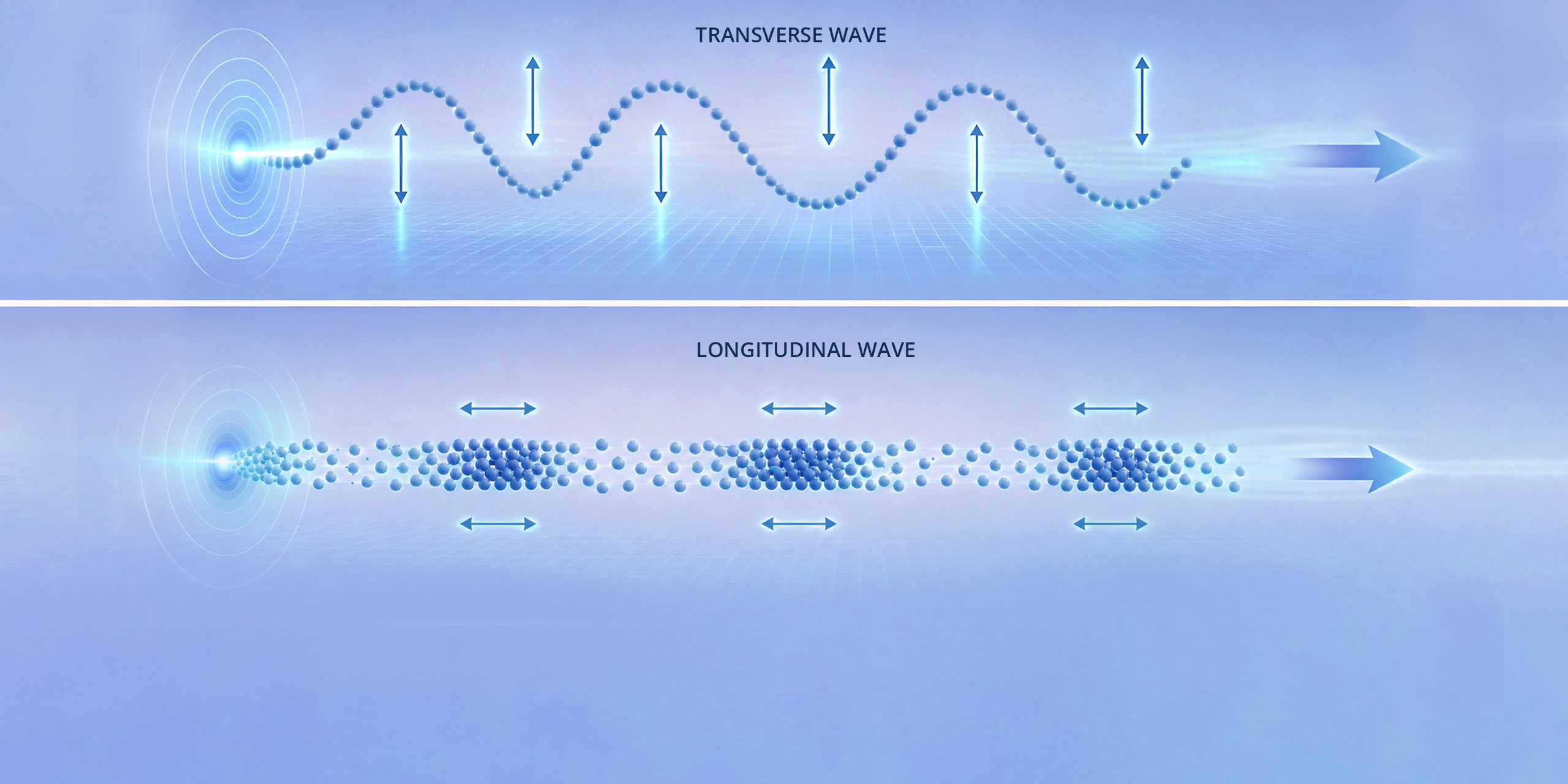
Standard electromagnetic waves are transverse. This means the oscillating electric and magnetic fields are perpendicular to the direction the wave travels. Light, radio waves, microwaves, all travel this way. Heaviside’s formulation of Maxwell’s equations, which is what mainstream physics uses, does not support the free propagation of purely longitudinal electromagnetic waves in a vacuum [2].
Scalar healing researchers, particularly in the tradition of Nikola Tesla and Konstantin Meyl, argue that the Heaviside simplification excluded a class of longitudinal waves from the framework, waves that oscillate in the direction they travel rather than perpendicular to it. Meyl’s theoretical work proposes that these longitudinal components, which he associates with the scalar potential, can propagate through matter in ways that transverse waves cannot, and that they interact with biological systems differently from conventional electromagnetic radiation [5].
This is where the genuine scientific controversy sits. Mainstream physics does not accept free-space longitudinal electromagnetic wave propagation as a phenomenon that the standard framework predicts or supports. Meyl and others argue this is precisely because the simplification removed the relevant terms. The disagreement is not about whether the scalar potential is real. Both sides agree on that. The disagreement is about whether scalar potentials can propagate independently and longitudinally in the way that scalar healing theory requires.
The claim of information without energy transfer
Another distinction that scalar healing researchers draw concerns the relationship between energy and information. Conventional electromagnetic fields carry both energy and information together. A radio wave carries information encoded in the modulation of its energy.
Some scalar healing frameworks propose that scalar fields can carry information without the corresponding energy transfer that conventional fields require. In this view, the body responds not to the energy of the field but to its informational structure. This is the theoretical basis for claims about imprinting, molecular scalar delivery, and the idea that the body can receive the signature of a substance without receiving its chemistry [6].
This claim has no clear foundation in standard electromagnetic theory. It is an extension that some researchers in biophysics find conceptually interesting, particularly in light of Popp’s biophoton research and Montagnier’s work on electromagnetic signals from DNA, but it has not been experimentally validated to mainstream scientific standards. It is best described as a theoretical proposal, not an established phenomenon.
Part 4 — What Standard Physics Does and Does Not Support
It is worth being precise here, because this is the area where both enthusiasts and skeptics often overstate their position.
What standard physics clearly supports: scalar fields as mathematical objects are real and well-defined. The scalar potential of the electromagnetic field is a physically real quantity, confirmed by the Aharonov-Bohm experiment. Scalar fields govern some of the most fundamental processes in nature. The Higgs field, which gives particles their mass, is a scalar field confirmed by experiment at CERN in 2012. Scalar fields appear in the leading cosmological models for dark energy. None of this is disputed [7].
What standard physics does not support, or at least has not confirmed: the free propagation of purely longitudinal electromagnetic waves in vacuum. The ability of electromagnetic potentials to carry biological information independently of energy transfer. The specific mechanisms proposed by Meyl, Bearden, and others for how scalar fields interact with living systems. These remain theoretical proposals at the edge of current knowledge, not established findings [2].
The honest position is that the scalar potential is real, its physical effects are confirmed, and the further claims built on top of that confirmation range from plausible hypotheses to speculation. Different people will draw the line between those categories differently. What matters is being clear about where the established physics ends and the interpretation begins.
Part 5 — Why the Distinction Matters for Scalar Healing
Understanding this distinction has practical implications for anyone engaging with scalar healing technology or research.
When a scalar healing device is described as producing a field that cannot be detected by conventional instruments, this claim is coherent within the scalar theoretical framework but not independently verified. It is true that if scalar fields propagate longitudinally through the scalar potential rather than as transverse electromagnetic waves, they would not be detected by instruments designed to measure the electric and magnetic field components of transverse waves. Whether that is what is actually happening in a given device is a separate empirical question [6].
When practitioners report that sitting within a scalar field produces perceptible effects on the body, those reports are meaningful data, even if the mechanism is unclear. The body is sensitive to electromagnetic fields, including weak fields, through well-documented mechanisms in bioelectromagnetics. Whether the additional scalar components proposed by Meyl and others contribute effects beyond those conventional fields produce is exactly the question that has not been cleanly answered by experiment.
When the Aharonov-Bohm effect is cited as evidence that scalar fields have physical effects, this citation is accurate and relevant. The effect confirms that electromagnetic potentials are not merely mathematical tools. It does not, on its own, confirm the specific biological effects claimed for scalar healing. It establishes the physical reality of the underlying phenomenon, which is a meaningful foundation but not the whole argument [4].
Part 6 — The Most Honest Answer to the Question
Are scalar fields and electromagnetic fields the same thing?
They are neither identical nor completely separate. The scalar potential is a component of the electromagnetic field in the broadest sense: it is part of what physicists call the electromagnetic four-potential, a unified mathematical object that encompasses both scalar and vector components in the full relativistic description of electromagnetism. In that sense, you cannot have an electromagnetic field without a scalar potential component [3].
But the scalar potential is not the same as the electric and magnetic fields that Heaviside’s simplified equations focus on. It can produce physical effects in regions where those fields are zero, as the Aharonov-Bohm experiment proves. It may carry physical information and produce physical effects through mechanisms that the Heaviside formulation does not capture. Whether those additional effects include the longitudinal wave propagation and biological interaction proposed by scalar healing researchers is a question that physics has not yet settled.
The most careful way to frame it is this: scalar fields are real, are part of electromagnetic theory, and are confirmed to produce physical effects. The specific properties attributed to scalar fields in healing contexts, the longitudinal propagation, the information-without-energy transfer, the direct interaction with biological control systems, are theoretical extensions of that confirmed foundation. Some are more grounded than others. All deserve continued investigation rather than either confident acceptance or confident dismissal.
Scalar healing does not require physics to be wrong. It requires physics to be incomplete in the specific way that Maxwell's original framework suggested and that the Aharonov-Bohm effect partially confirmed. Whether the incompleteness runs as deep as scalar healing proposes is the open question at the heart of this field, and it is a genuinely interesting one.
Resources:
- [1] Griffiths, D. J. (2017). Introduction to Electrodynamics (4th ed.). Cambridge University Press. [Standard reference on scalar and vector fields, electromagnetic potentials, and Maxwell’s equations]
- [2] Hunt, B. J. (2005). The Maxwellians. Cornell University Press. [Historical account of the Heaviside reformulation of Maxwell’s equations and its theoretical consequences]
- [3] Maxwell, J. C. (1865). A dynamical theory of the electromagnetic field. Philosophical Transactions of the Royal Society of London, 155, 459-512. https://doi.org/10.1098/rstl.1865.0008
- [4] Aharonov, Y., & Bohm, D. (1959). Significance of electromagnetic potentials in the quantum theory. Physical Review, 115(3), 485-491. https://doi.org/10.1103/PhysRev.115.485
- [5] Meyl, K. (2001). Scalar Wave Transceiver Technology. INDEL GmbH. [Meyl’s theoretical framework proposing longitudinal scalar wave propagation beyond the Heaviside formulation; www.meyl.eu]
- [6] Bearden, T. E. (2002). Energy from the Vacuum: Concepts and Principles. Cheniere Press. [Bearden’s extension of scalar potential theory into biological and energy applications]
- [7] ATLAS Collaboration. (2012). Observation of a new boson at a mass of 125 GeV with the CMS experiment at the LHC. Physics Letters B, 716(1), 30-61. https://doi.org/10.1016/j.physletb.2012.08.021 [Confirmation of the Higgs field, a scalar field, as a physical reality]
- [8] Oschman, J. L. (2000). Energy Medicine: The Scientific Basis. Churchill Livingstone. [Background on bioelectromagnetic field effects in living systems and the theoretical basis for field-based medicine]