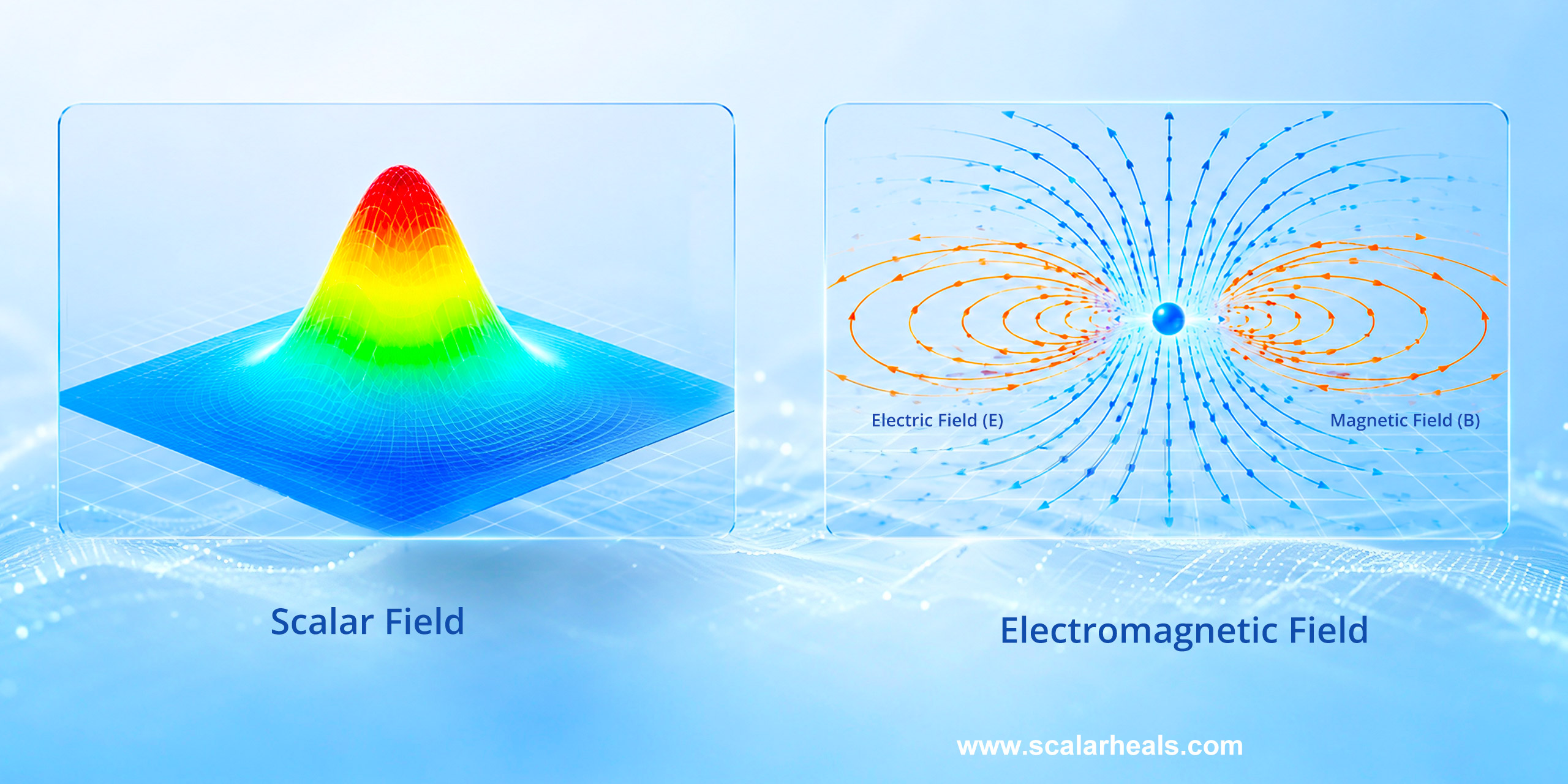
Every wave that exists in nature, from the sound of a voice to the light of a star, moves in one of two fundamental ways. It either shakes the medium it travels through sideways, perpendicular to its direction of travel, or it pushes and pulls the medium forward and backward along the very path it is following. The first kind is called a transverse wave. The second is called a longitudinal wave.
This is not a subtle distinction buried in advanced physics. It is one of the most basic classifications in wave mechanics, taught in high school science courses. But it becomes important, and genuinely contested, when you ask which category electromagnetic waves belong to, and whether the answer is as simple as most textbooks suggest.
In scalar research and in the tradition running from Nikola Tesla through to Konstantin Meyl, the possibility of longitudinal electromagnetic waves sits at the center of everything. Tesla described his most important discoveries in terms of waves that did not behave like the transverse Hertzian radiation that Heinrich Hertz had demonstrated in 1887. Meyl has built an entire theoretical framework around the claim that longitudinal electromagnetic components exist and propagate in ways the standard model does not account for. Understanding what they mean by that requires understanding the wave distinction clearly, from the physics up.
Part 1 — Transverse Waves: The Wave You Are Probably Imagining
Picture a long rope stretched out horizontally. Someone at one end flicks their wrist up and down. A wave travels along the rope from one end toward the other. The rope itself moves up and down while the wave moves left to right. The motion of the rope and the direction of the wave’s travel are perpendicular to each other. That is a transverse wave [1].
Waves on the surface of water work the same way. The water moves up and down while the wave pattern travels across the surface. Ocean waves are a slightly more complex version of this, but the core geometry is the same: the oscillation and the travel direction are at right angles.
Light is a transverse wave. Radio waves are transverse waves. Microwaves, X-rays, infrared, ultraviolet, and gamma rays are all transverse waves. The entire electromagnetic spectrum as described by Maxwell’s equations in their standard Heaviside formulation consists of transverse waves, in which the electric field oscillates in one direction perpendicular to travel and the magnetic field oscillates in another direction also perpendicular to travel, with the two fields at right angles to each other and both at right angles to the direction the wave is moving [2].
This is not an approximation. For standard electromagnetic radiation in free space, the transverse character of the wave is an exact consequence of Maxwell’s equations. The mathematical condition that produces it is called Gauss’s law for electricity, which requires that electromagnetic waves in a charge-free vacuum have no component of the electric field in the direction of propagation. No longitudinal electric component, no longitudinal electromagnetic wave. This is settled, textbook physics [2].
Part 2 — Longitudinal Waves: Compression and Rarefaction
Now imagine a Slinky coil spring stretched out horizontally. Someone pushes one end forward. The coils at that end compress together, and then that compression travels along the spring toward the other end. Behind the compression, the coils spread apart again, creating a zone of rarefaction. The spring is oscillating forward and backward, in the same direction the wave is moving. That is a longitudinal wave [1].
Sound is the most familiar longitudinal wave. When something vibrates in air, it alternately compresses and decompresses the air molecules around it, and those compressions and rarefactions travel outward as a pressure wave. The air molecules themselves do not travel across the room. They oscillate back and forth locally, in the direction the sound is traveling, while the pattern of compressions moves through them.
Seismic P-waves, which travel through the body of the Earth during earthquakes, are also longitudinal. Ultrasound waves used in medical imaging are longitudinal. Any wave traveling through a compressible medium, whether gas, liquid, or solid, can be longitudinal because the medium can be compressed and expanded along the direction of travel [1].
The key physical requirement for a longitudinal wave is that the medium can be compressed. Air compresses. Water compresses slightly. Solids compress. In all these cases, longitudinal waves are not only possible but entirely natural. They are what happens when a disturbance pushes rather than shakes.
Part 3 — Why Electromagnetic Waves Are Transverse in Standard Theory
The reason electromagnetic waves in free space are transverse comes directly from the structure of Maxwell’s equations. Two of the four equations, Gauss’s law for electricity and Gauss’s law for magnetism, impose constraints on how electric and magnetic fields can vary in space. In a region with no charges and no currents, these constraints require that the components of the electric and magnetic fields along the direction of wave propagation must be zero. Mathematically, this forces electromagnetic waves in vacuum to be purely transverse [2].
This is not a result that physicists have found surprising or controversial. It follows cleanly from the equations. It has been confirmed by over a century of experiment. Every radio antenna ever built, every piece of electromagnetic technology ever designed, works on the assumption of transverse electromagnetic waves. And it works.
Longitudinal electromagnetic waves can exist in certain special contexts. In a plasma, which is an ionized gas, the free electrons can oscillate back and forth in the direction of wave travel, creating what are called plasma oscillations or Langmuir waves. These are longitudinal electromagnetic oscillations, and they are real, documented, and studied extensively in plasma physics [3]. In a conductor, at the boundary of a metal surface, certain electromagnetic surface waves can have longitudinal components. In quantum field theory, virtual photons exchanged between charged particles can be thought of as having longitudinal components. None of these challenge Maxwell’s equations. They are all consistent with the standard framework, applied to special conditions.
What does not exist in standard electromagnetic theory, and what remains genuinely controversial, is the claim that purely longitudinal electromagnetic waves can propagate freely through empty space or through ordinary matter as an independent phenomenon, outside of the special conditions that permit them in plasmas or conductors.
Part 4 — Tesla, Non-Hertzian Waves, and the Longitudinal Claim
Nikola Tesla was famously dismissive of Heinrich Hertz’s discovery of electromagnetic waves in 1887. Not because he doubted that Hertz had produced electromagnetic radiation, but because he believed Hertz had discovered only one category of what was possible. Tesla called Hertz’s waves Hertzian radiation, and he contrasted them with what he described as non-Hertzian disturbances, which he claimed were fundamentally different in their propagation behavior [4].
Tesla’s specific claim was that oscillating electric potential could propagate as a longitudinal disturbance through the Earth and through the atmosphere, rather than radiating outward as transverse waves through the air. This is why Wardenclyffe Tower was designed the way it was. Its enormous underground shafts, extending down to the water table, were meant to couple the device directly to the Earth as a conductor, not to radiate energy upward into the sky. Tesla envisioned the Earth as the transmission medium, with longitudinal compression waves of electric potential traveling through the planet itself [4].
Whether Tesla was observing something genuinely distinct from Hertzian radiation, or whether his observations could be accounted for within the standard framework applied to unusual conditions, has never been definitively settled. His Colorado Springs experiments produced results he interpreted as evidence of Earth resonance at frequencies he had calculated for longitudinal propagation through the Earth. Those same results have been interpreted by others as consistent with the Schumann resonances, which are conventional transverse electromagnetic resonances in the Earth-ionosphere cavity, first predicted by Winfried Otto Schumann in 1952 and confirmed by measurement [5].
The interpretive gap between these two readings of Tesla’s experiments is significant. In one reading, Tesla was detecting a new class of wave altogether. In the other, he was detecting a phenomenon that fits neatly within standard electromagnetic theory, albeit one that was not yet formally described in his lifetime. Neither reading can currently be excluded on the basis of the experimental record he left behind.
Tesla's insistence on the non-Hertzian character of his experiments was not arbitrary. He was making a specific physical claim: that the waves he was working with propagated through matter rather than through the air, at different speeds than light, and without the energy losses that radiation into space would entail. These are testable predictions. They were not adequately tested in his lifetime. They have not been definitively resolved since.
Part 5 — Meyl's Framework: Longitudinal Waves as Scalar Waves
The most systematic modern attempt to formalize Tesla’s intuitions into a rigorous theoretical framework comes from Konstantin Meyl. His argument begins with the observation, covered in earlier articles in this series, that Heaviside’s reformulation of Maxwell’s equations made a specific mathematical choice: it eliminated the scalar potential as a physical quantity and reduced the electromagnetic framework to one that describes only transverse wave solutions.
Meyl argues that if you go back to Maxwell’s original formulation, with the scalar potential treated as a physical quantity rather than a mathematical convenience, the equations admit an additional class of wave solutions beyond the transverse Hertzian type. These additional solutions are longitudinal. They involve oscillations of the scalar potential propagating in the direction of travel. He calls them scalar waves, though the term potential vortex waves more precisely captures his theoretical model [6].
Several of Meyl’s predicted properties for these waves, if they exist as he describes, would be quite different from transverse electromagnetic radiation. They would not carry energy in the same way, or lose intensity with distance in the same way as radiated electromagnetic waves. They would interact with matter differently, particularly with biological systems. They would, in principle, be able to propagate through shielding that blocks conventional electromagnetic radiation [6].
Meyl has built transmitter-receiver apparatus to demonstrate his claims experimentally. Independent researchers have replicated some of his results, observing energy transfer between transmitter and receiver under conditions that Meyl argues cannot be explained by conventional electromagnetic induction. The scientific community’s mainstream assessment is that these results, while not easily dismissed, can potentially be explained within the standard framework as near-field electromagnetic coupling rather than as a new class of wave. The debate continues [6].
Part 6 — What Established Physics Actually Permits
It is worth being precise about what current physics can and cannot accommodate on this question, because the honest answer is more nuanced than most popular accounts suggest.
Standard electromagnetic theory does not predict free-space longitudinal electromagnetic waves in vacuum. This is a direct consequence of Maxwell’s equations and is not in dispute among physicists [2].
Standard electromagnetic theory does permit longitudinal electromagnetic oscillations in special media: plasmas, conductors, and certain metamaterials. These are not controversial. They are well-studied phenomena with engineering applications [3].
The Aharonov-Bohm effect confirms that electromagnetic potentials are physically real and produce effects independent of the fields in certain quantum mechanical situations. This does not directly predict longitudinal wave propagation, but it does confirm that the scalar potential has physical consequences beyond what the Heaviside field equations capture [7].
The theoretical claim that longitudinal electromagnetic waves can propagate freely through space or through biological tissue as a distinct phenomenon, independent of the special conditions that permit them in plasmas or conductors, is not supported by the standard framework. Whether the standard framework is complete enough to make that determination is the question that Meyl and others are raising, and which has not been settled by experiment to mainstream satisfaction.
Part 7 — Why This Matters for Scalar Healing
The longitudinal wave question is not an abstract physics debate for anyone interested in scalar healing. It sits directly beneath some of the most important practical claims in the field.
If scalar waves are longitudinal, they would propagate differently from conventional electromagnetic radiation. They would not be blocked or attenuated by electromagnetic shielding. They would interact with the body through a mechanism distinct from the electric and magnetic field induction that bioelectromagnetics research has documented. These differences would be what makes scalar healing qualitatively different from other electromagnetic therapies rather than simply a variation on conventional electromagnetic stimulation [6].
If, on the other hand, what scalar devices produce is primarily conventional electromagnetic radiation in the near-field, with possible contributions from scalar potential components of the Aharonov-Bohm type, the biological effects would be real but would fall within the existing framework of bioelectromagnetics. Some of what practitioners observe might still be genuine. The mechanism would be less radical than the longitudinal wave theory proposes.
The honest position is that we do not yet have the experimental tools and the carefully designed studies needed to distinguish between these possibilities. Scalar healing devices have not been subjected to the kind of rigorous, blinded, instrument-verified research that would let us characterize exactly what they are producing and through what mechanism the body is responding. That is not a reason to dismiss the field. It is a description of where it currently stands.
Tesla believed he was working with a class of wave that Heinrich Hertz had not discovered. Meyl believes the mathematical framework to describe those waves is sitting, unused, in Maxwell’s original equations. Whether they are right is one of the most interesting open questions in the physics of electromagnetism. It is also, practically speaking, one of the most important open questions for anyone building or using technology that claims to work through scalar field effects.
Sound is longitudinal. Light is transverse. Both are waves. The difference in how they propagate, what they can pass through, and how they interact with matter is enormous. If electromagnetic fields can produce longitudinal components of the kind Tesla and Meyl describe, the implications for energy, medicine, and communication would be equally significant. That is why this question, which began in a nineteenth-century dispute about the nature of electrical oscillations, has never fully gone away.
Resources:
- [1] French, A. P. (1971). Vibrations and Waves. W. W. Norton and Company. [Classic undergraduate physics text covering transverse and longitudinal wave mechanics with clear physical derivations]
- [2] Griffiths, D. J. (2017). Introduction to Electrodynamics (4th ed.). Cambridge University Press. [Standard reference on Maxwell’s equations, Gauss’s law constraints, and the transverse character of electromagnetic waves in free space]
- [3] Balanis, C. A. (2012). Advanced Engineering Electromagnetics (2nd ed.). Wiley. [Covers longitudinal electromagnetic modes in plasmas, waveguides, and special media within the standard framework]
- [4] Tesla, N. (1978). Colorado Springs Notes, 1899. Nolit. [Tesla’s experimental notebooks documenting his observations of non-Hertzian wave phenomena and Earth resonance experiments]
- [5] Schumann, W. O. (1952). On the free oscillations of a conducting sphere which is surrounded by an air layer and an ionosphere shell. Zeitschrift fur Naturforschung A, 7, 149-154. [Original prediction of the Earth-ionosphere resonances that bear Schumann’s name, providing an alternative framework for interpreting Tesla’s Colorado Springs observations]
- [6] Meyl, K. (2001). Scalar Wave Transceiver Technology. INDEL GmbH. [Meyl’s full theoretical and experimental treatment of longitudinal scalar waves as potential vortex solutions to the extended Maxwell equations; www.meyl.eu]
- [7] Aharonov, Y., & Bohm, D. (1959). Significance of electromagnetic potentials in the quantum theory. Physical Review, 115(3), 485-491. https://doi.org/10.1103/PhysRev.115.485
- [8] Hunt, B. J. (2005). The Maxwellians. Cornell University Press. [Historical context for the Heaviside reformulation and its elimination of the scalar potential as a physical quantity from the working framework of electromagnetism]