
In the ongoing exploration of wireless energy transmission and longitudinal electromagnetic waves, the experimental work of Prof. Dr. Konstantin Meyl frequently serves as a focal point for discussion. Inspired by Nikola Tesla’s early high-voltage research, Meyl designed a specific demonstration kit to prove the existence and practical application of what he identifies as electric scalar waves (Meyl, 2001). To evaluate the validity of these claims, it’s necessary to objectively examine the purpose, physical setup, observed results, and the scientific challenges surrounding the reproduction of this experiment.
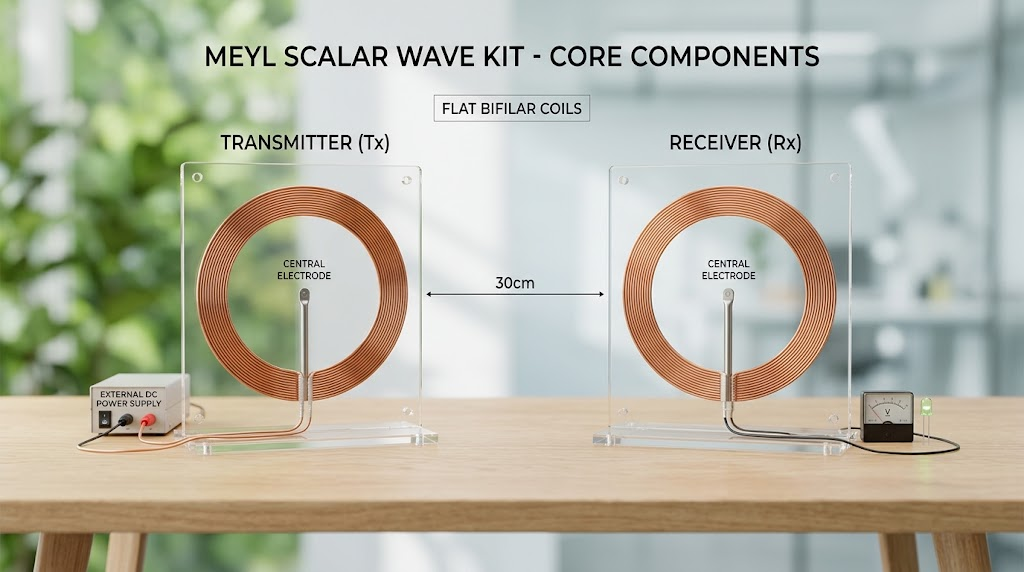
The Experimental Setup: Transmitter and Receiver
The primary objective of Meyl’s experiment is to demonstrate that electrical energy and information can be transmitted wirelessly using longitudinal waves, which theoretically do not degrade in the same manner as standard transverse Hertzian waves (Meyl, 2001).
The experimental apparatus is relatively compact, consisting of two main components: a transmitter and a receiver. Both units utilize flat and spirally wound bifilar coils (often referred to as pancake coils) topped with spherical antennas. The transmitter is connected to a low-voltage signal or waveform generator. The receiver circuit, placed at a physical distance from the transmitter, is connected to a small electrical load, typically light-emitting diodes (LEDs), to visually indicate when energy is successfully received.
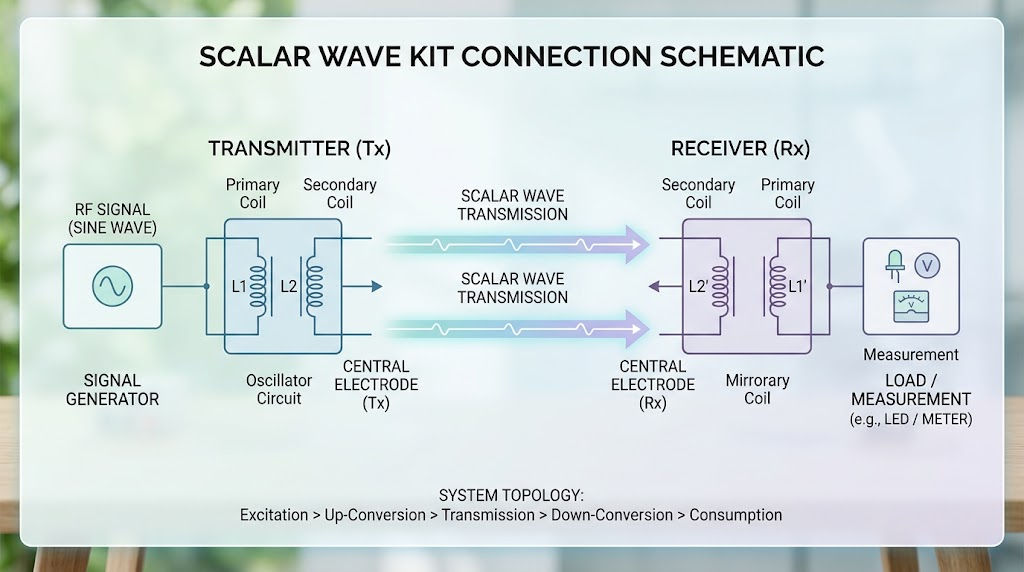
The Process and Observed Results
During the experiment, the waveform generator feeds a high-frequency, low-voltage AC signal into the transmitter. According to Meyl, when the frequency is precisely tuned to achieve resonance between the two spherical antennas, several notable phenomena occurred.
First, Meyl reported that the LEDs on the receiver board illuminate brightly, while the corresponding LEDs on the transmitter board dimmed, suggesting a highly efficient wireless energy transfer (Meyl, 2001). Furthermore, Meyl documented that this energy transmission appears to penetrate Faraday cages, which are metal enclosures designed to block standard transverse electromagnetic waves. He also claimed that measurements of the wave propagation indicated speeds exceeding the speed of light (superluminal velocity) and that the system occasionally demonstrated an over-unity effect, where the receiver seemingly collected more power than was input into the transmitter (Meyl, 2001).
The Challenge of Independent Reproduction
While the visual demonstration of wireless power transfer is easily replicated using Meyl’s kit, independent researchers have encountered significant issues when attempting to reproduce and validate the underlying causes of these results (Weidner et al., 2003).
The primary challenge lies in the interpretation of the data. Conventional physics argues that the observed effects do not require the existence of novel scalar waves. Instead, independent evaluations suggest that the lighting of the LEDs and the high efficiency of the power transfer can be fully explained by standard near-field electromagnetic coupling and parasitic capacitance between the resonant circuits (Bruhn, 2001). Because the transmitter and receiver are placed relatively close to one another, they operate within the near-field region where traditional electromagnetic laws naturally allow for strong inductive coupling.
Additionally, critics note that the claims of superluminal speeds and over-unity energy are often the result of measurement errors inherent in interpreting complex phase shifts within high-frequency resonant circuits (Bruhn, 2001). Therefore, while the physical apparatus successfully transmits power over short distances, the objective reproduction of Meyl’s specific scalar wave theories remains highly disputed within the broader scientific community.
References
Bruhn, G. W. (2001). On the existence of K. Meyl’s scalar waves. Journal of Scientific Exploration, 15(2), 206-210.
Meyl, K. (2001). Scalar waves: Theory and experiments. Journal of Scientific Exploration, 15(2), 199-205.
Weidner, H., Zentgraf, E., Senkel, T., Junker, T., & Winkels, P. (2003). Experiments to proof the evidence of scalar waves: Tests with a Tesla reproduction. Institut für Gravitationsforschung.