Imagine a device that could pull electricity out of thin air, with no batteries and no fuel. That was Thomas Henry Moray’s goal. He believed that the universe is filled with a “sea of radiant energy” and that he could build a receiver to catch it, just like a radio antenna catches radio waves.
Moray, an electrical engineer from Salt Lake City, created a device in the 1920s and 1930s that he claimed could tap into this energy. He called it the “Radiant Energy Device” or the “Cosray Receiver”, making him one of the most intriguing figures in alternative-energy history.
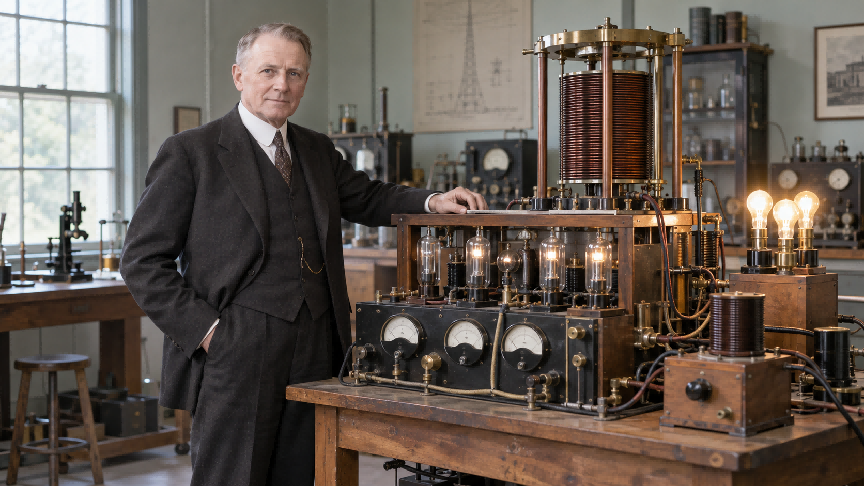
The Main Components
Moray’s device was described as similar to a radio receiver but for power. Its key parts were:
- The Antenna and Ground:A large antenna to catch the radiant energy and a ground rod to complete the circuit.
- The “Moray Valve”:This was the secret. It was an early solid-state device, a cold cathode tube, which contained a mixture including germanium, triboluminescent zinc, and a radioactive material. This valve was the heart of the machine, acting as a detector and rectifier.
- High-Voltage Components:The device used large capacitors and transformers to handle the extremely high voltages (reportedly at least 200,000 volts) that were captured at the first stage.
How the Moray Radiant Energy Experiment Worked
The experiment used an antenna and earth ground feeding a sealed arrangement of capacitors, transformers, and detectors. Moray first “primed” and tuned the circuit, sometimes by moving a magnet across contacts. The output was then connected to resistive loads that made electrical activity visible through incandescent lamps and an electric iron. Disconnecting either the antenna or ground extinguished the lamps, reconnecting them could restore operation if the tuning had not been lost (Moray & Moray, 1978).
The device worked like a powerful radio receiver for energy, not sound. Here’s the basic idea in simple steps:
- Collect the Energy:A large antenna was used to capture high-voltage “radiant” energy from the air. This energy was thought to come from cosmic rays and the environment.
- Tune and Convert:This captured energy was fed into a complex circuit with special components. The most important part was a secret, specially made “valve” or detector tube. This was a semiconductor device (like an early transistor) that Moray invented. It used a mysterious crystal he found in Sweden to convert the high-voltage, high-frequency energy into a usable, low-voltage electrical current.
- Amplify the Power:The device used a “stage-by-stage” amplification system, which Moray called a “bucket brigade” amplifier, to boost the tiny amount of captured energy into a powerful electrical output.
What Were the results
Thomas’ machine could light up 35 100-watt light bulbs, run a 1200-watt iron, and power a small motor simultaneously, and his largest device was said to produce up to 50,000 watts (50 kW) of power and could run for several days.
There were no visible power source. independent engineers inspected the device and couldn’t find any hidden batteries or power connections. It was even tested far away from power lines and inside a sealed container to prove it was self-contained.
What the witness records establish
The invited observers reported seeing ordinary loads operate while the apparatus appeared to have no conventional mains connection. Some inspected the antenna, ground, and visible components, and tests were also done at locations away from power lines. These records are historically meaningful, but most were preserved in Moray-associated publications rather than being replicated in independent laboratory reports.
What Was Missing from Scientific Verification
Moray therefore demonstrated a striking reported effect, loads operating during controlled-looking presentations, but not a verified source of net new energy. The historical record preserves the observation and the claim, but it doesn’t provide enough evidence to establish where the power came from or whether the receiver could be independently reproduced.
Also, there were some other skepticism and controversy present. Despite the demonstrations, the U.S. Patent Office refused to grant Moray a patent, partly because the patent examiner couldn’t understand how his cold cathode valve worked. No one was ever able to fully explain or replicate his device after his death. The original device was destroyed in 1941 by an assistant, and the secret of its operation was lost.
References
Moray, T. H., & Moray, J. E. (1978). The sea of energy in which the Earth floats (5th ed.). Cosray Research Institute. https://archive.org/details/seaofenergy0000then