Part 1 — A Machine That Shouldn't Have Worked
Imagine walking into a laboratory sometime in the 1930s.
Dozens of electric light bulbs are glowing brightly. A flat iron is running. A heater is producing warmth. The room is alive with electrical activity.
There are no power lines running to the building. No generator in the corner. No battery bank. No visible conventional power source of any kind.
Only a compact device sitting quietly on a table — a metal box connected to an antenna and a grounding rod, weighing roughly 55 kilograms, containing a complex internal arrangement of components that its inventor refused to fully disclose.
The inventor, Thomas Henry Moray, would explain to you that the electricity was not coming from any conventional source. It was coming, he said, from a form of energy that already existed throughout nature — flowing through the cosmos, available everywhere, untapped by conventional science. He called it Radiant Energy.
Engineers walked into that laboratory and could not find the hidden power source. Scientists from some of the most respected institutions in the United States witnessed the demonstrations and left without an explanation. The device was tested in remote locations miles from any power line. It reportedly ran for days at a time.
And yet it never became part of mainstream science. The device was ultimately destroyed. The inventor died without achieving the recognition he believed his work deserved. His claims were never conclusively proven — and never conclusively disproven.
Nearly a century later, Moray's work continues to appear in discussions about Radiant Energy, Vacuum Energy, and Scalar Energy. Not because it proved any of these ideas — but because it left behind a question that science has never completely stopped asking: Could nature contain forms of energy that we do not yet fully understand?
Part 2 — Who Was Thomas Henry Moray?
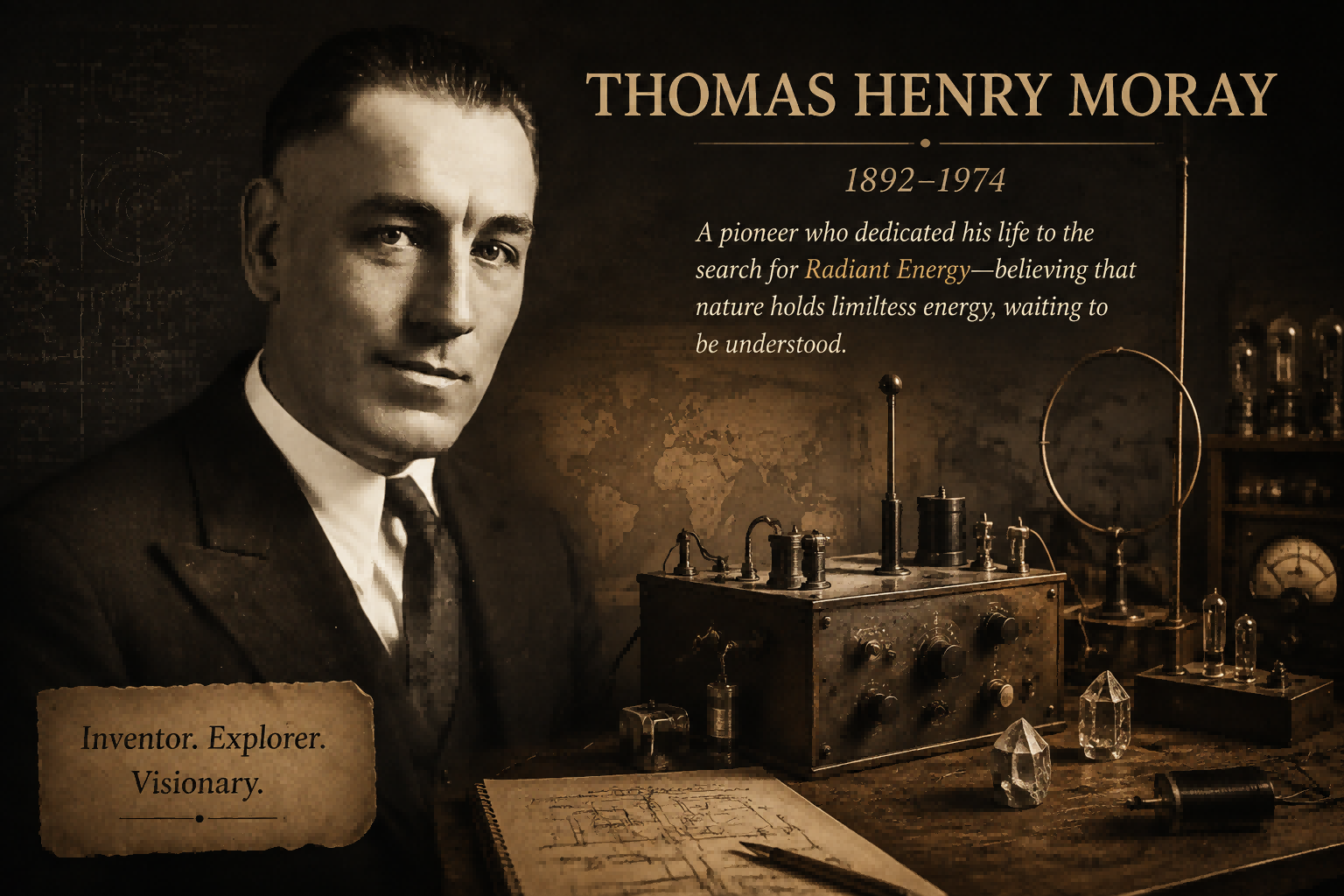
Thomas Henry Moray was born on 28 August 1892 in Salt Lake City, Utah. He died on 18 May 1974. In the eight decades between those two dates, he produced what is either one of the most significant unrecognised inventions in the history of electrical engineering — or one of its most puzzling unsolved mysteries.
He was a self-taught man in many respects. He attended the LDS Business College, studied electrical engineering largely through correspondence courses, and later earned a doctorate from the University of Uppsala in Sweden [1]. That Swedish connection turned out to be significant — it was during his time as a church missionary in Sweden in 1911 that Moray encountered the early radio technologies that would shape his thinking about energy detection, and where he discovered the mysterious mineral component that would become central to his device.
As a boy, Moray had been fascinated by crystal radio sets — the early devices that used a small piece of mineral crystal as a rectifying detector to convert radio waves into electrical current. The challenge was always to find the right crystal: a material that could detect and rectify incoming electromagnetic energy with maximum efficiency. Moray spent years searching for better materials, and his thinking developed far beyond the modest scope of crystal radio. He became convinced that the atmosphere and the cosmos themselves were filled with oscillating energy of enormous magnitude — energy that flowed continuously through all of nature but had never been systematically tapped.
His central ambition was not incremental improvement of existing technology. It was something more fundamental: to investigate whether usable energy already existed in nature, moving through it freely, and whether a sufficiently sensitive device could detect, resonate with, and extract it without consuming any conventional fuel or requiring any conventional power input.
This put him squarely in the tradition of Nikola Tesla, whom he admired and whose ideas about energy transmission through the Earth directly influenced his own thinking. Like Tesla at Wardenclyffe, Moray believed the planet and the space surrounding it were alive with energy that conventional electrical engineering had not learned how to access [2].
Part 3 — What Was the Radiant Energy Device?
Moray built his first working prototype in 1925. It consisted of a large antenna — necessary, he believed, to couple with the incoming energy from the cosmos — connected to a grounding rod, and then to the device itself: a carefully constructed box containing high-voltage capacitors, transformers, and what he described as a series of special valve tubes [1].
The critical component — and the most mysterious — was what Moray called the Swedish stone. He had found the material during his time in Sweden, and he guarded its identity closely throughout his life. Analysis later suggested it may have been spodumene, a lithium-bearing mineral with semiconducting properties — though this has never been confirmed definitively [2]. A silver wire in contact with the stone acted as a rectifier: a device that converts alternating current into direct current. Moray used this stone element as both a detector and an amplifier of the incoming Radiant Energy, operating on principles he compared to those of a germanium diode — a solid-state semiconductor device — at a time when semiconductor technology was not yet understood or developed by mainstream science.
The device reportedly produced electricity with an unusual characteristic that Moray called cold current. Thin wires that would normally heat up and burn through when carrying significant electrical power could conduct it without measurable heating. This was one of the properties that most puzzled the engineers and scientists who examined the device — it did not behave like ordinary alternating or direct current [3].
The claimed output of the final versions of the device was extraordinary: up to 50 kilowatts of electrical power, capable of running for several days without interruption. To put that in context, 50 kilowatts is sufficient to power a small commercial building or dozens of homes. If genuine, it would represent one of the most significant energy discoveries in history [1].
Moray never fully disclosed the internal design of the device. He applied for patents but was repeatedly rejected — the United States Patent Office requiring him not merely to demonstrate the effect, but to identify the energy source, which he could not do to the examiner’s satisfaction. The critical components were never independently reproduced. Those two facts — the demonstrated effects on one hand, the undisclosed mechanism on the other — define the core of the Moray puzzle [4].
Part 4 — What Happened After the Demonstrations?
Rather than keeping his invention hidden, Moray made a deliberate choice to demonstrate it publicly and repeatedly throughout the 1920s and 1930s. He invited observers, welcomed scrutiny, and collected written testimonials from witnesses — reportedly dozens of them over the years.
The demonstrations attracted a remarkably broad range of observers. Engineers and scientists from Bell Laboratories attended. Representatives from the United States Department of Agriculture examined the device. Journalists wrote about it. Investors explored the possibility of commercialisation. Government officials visited his laboratory [1].
One of the most striking demonstrations took place in a location miles from any power line, where the device was set up and operated in a genuinely remote setting. On that occasion, witnesses reportedly heard Admiral Byrd broadcasting from his Antarctic exploration base Little America via the device — an event meant to demonstrate both the device’s independence from local power infrastructure and its ability to receive signals from extraordinary distances [3].
Observers consistently reported that they could find no evidence of fraud — no hidden cables, no concealed batteries, no conventional power source. Engineers who attempted to identify how the device could be producing power without a known input came away without an explanation. Yet those same investigations never produced a conclusion that satisfied mainstream science either. Nobody could confirm what the energy source actually was. Nobody could reproduce the device independently. The demonstrations were compelling. The verification was incomplete [1].
What made Moray’s work genuinely difficult to dismiss — unlike many fringe inventors — was the seriousness of the institutions whose representatives attended and the quality of the witness testimonials he collected. These were not casual observers. These were trained technical professionals who examined the device with scepticism and left unable to explain it. That is a different category of evidence from simple anecdote.
At the same time, it is equally important to state clearly what the demonstrations did not produce: independent, reproducible verification under controlled scientific conditions. By the standards that mainstream science requires, the evidence never crossed that threshold. The demonstrations were observed. The device was not replicated. Those two things are true simultaneously, and both matter.
What made Moray's work remarkable was not that it had already proven a new theory of energy — it had not. It was that it posed a question that trained, sceptical investigators could not easily answer: if the demonstrations were genuine, where was the energy coming from?
Part 5 — Why Didn't It Become Mainstream Science?
The story of why Moray’s work faded from scientific attention is not a simple one, and it is worth being honest about the multiple factors involved — some of which reflect genuine scientific limitations, and some of which reflect circumstances beyond Moray’s control.
The most fundamental scientific obstacle was reproducibility. Moray’s device worked — or appeared to work — but only in his hands, with his components, under his conditions. No one else was able to build a working replica. This is the most basic requirement science has for accepting a new phenomenon as real: if you cannot reproduce it independently, you cannot build on it, test it, or verify it. Without reproducibility, the most dramatic demonstration remains exactly that — a demonstration, not a proof [4].
The Swedish stone was central to this problem. It was the component that Moray credited with the device’s detection and amplification capability, and it was the component whose identity and properties he never fully disclosed. When the stone was gone, the device could not be reconstructed. After Moray’s death in 1974, attempts were made to identify the material and understand its properties, but without a confirmed sample, these efforts remained speculative [2].
There was also no complete theoretical framework. Moray believed he was tapping into what he called the energy of the universe — a sea of oscillating energy that existed throughout the cosmos. He drew on Tesla’s ideas about energy transmission and on early quantum mechanical concepts that were just emerging during the period of his work. But he never produced a formal theoretical model that could be examined, tested, and challenged by physicists. Without a theory, even a working device has no framework within which science can understand, extend, or verify it [4].
The practical circumstances of Moray’s life added further barriers. He faced what he described as active suppression from interests who feared the commercial implications of free energy technology. Whether or not these fears were justified, the most concrete consequence came in 1939, when an assistant — reportedly frustrated by Moray’s refusal to sell the technology to corporate buyers — destroyed the primary working device [1]. Moray was also the target of a physical assault in his laboratory; he subsequently had his car fitted with bulletproof glass. By the time the device was destroyed, Moray’s ability to rebuild it completely was severely limited.
In 1944, the Rural Electrification Administration paid Moray $25 a day to attempt to perfect his system for drawing electrical energy from the atmosphere — suggesting that at least some government agencies took his claims seriously enough to fund further investigation [1]. But this effort did not produce the breakthrough that would have settled the question definitively.
The conclusion, stated plainly: Moray’s research did not disappear because a single experiment conclusively disproved it. It faded because the available evidence never accumulated to the level required for broad scientific acceptance — and because the physical device that might have produced that evidence was destroyed before the necessary independent verification could be achieved.
Part 6 — What Does Moray's Legacy Leave Us Today?
Thomas Henry Moray did not establish a new branch of physics. His device never became part of mainstream electrical engineering. Even today, nearly a century after his first demonstrations, it has not been independently reproduced to the standard required for scientific acceptance.
And yet his work continues to attract serious attention — not from credulous enthusiasts alone, but from researchers who engage carefully with the history and try to understand what, if anything, the Moray device was actually doing.
One modern interpretation comes from Moray B. King, a physicist and author who has written extensively on zero-point energy. King argues that the fundamental operating principle Moray stumbled upon — abrupt, synchronous ion surges in plasma that coherently activate the zero-point energy of the vacuum — can be supported by theoretical frameworks in modern physics that simply did not exist in Moray’s time [3]. Moray was working empirically, discovering phenomena without the theoretical tools to explain them. From this perspective, his device may have been accidentally accessing real physical effects that mainstream physics would later develop conceptual language for.
Whether that interpretation is correct is not established. Zero-point energy is real — it is the minimum energy a quantum mechanical system retains even at absolute zero, and it is confirmed physics [5]. Whether it can be extracted as usable power in the way Moray’s device reportedly demonstrated is a separate and unresolved question that modern physics has not yet answered definitively.
The connection to scalar energy is also worth naming directly. In the framework of this series, Moray belongs in the same experimental research line as Tesla: working at the intersection of electromagnetic potential, unconventional energy transmission, and the fundamental question of whether the fabric of space and the Earth itself carry forms of energy that conventional electrical engineering has not learned how to access. His device, whatever it was doing, was producing effects that did not fit neatly into the standard electromagnetic models of his time — the same standard models that Heaviside’s simplification of Maxwell had helped to establish [2].
What Moray left behind is not a proven technology. It is a question that has never been fully answered, attached to a body of witness testimony substantial enough to make simple dismissal feel intellectually dishonest.
Scientific progress does not always begin with certainty. It sometimes begins with a demonstration that existing models cannot explain, witnessed by credible people, that refuses to go away no matter how inconvenient it is. Moray’s Radiant Energy Device is that kind of unanswered question. Whether future research ultimately vindicates, revises, or finally disproves what he was claiming, it is a question that continues to deserve careful, honest investigation — which is, in the end, all that good science ever requires.
Resources:
- [1] Moray, J. E. (1978). The Sea of Energy in Which the Earth Floats (4th ed.). Cosray Research Institute. [Compiled by Moray’s son from Thomas Henry Moray’s original notes, patents, and documentation]
- [2] Grokipedia. (2026). Thomas Henry Moray. https://grokipedia.com/page/Thomas_Henry_Moray [Summary of biographical and technical details based on historical records]
- [3] King, M. B. (2002). The Energy Machine of T. Henry Moray: Zero-Point Energy and Pulsed Plasma Physics. Adventures Unlimited Press. [Modern physics interpretation of Moray’s device through zero-point energy and plasma oscillation frameworks]
- [4] Wikipedia. (2026). Thomas Henry Moray. https://en.wikipedia.org/wiki/Thomas_Henry_Moray [Overview of patent history, Rural Electrification Administration contract, and scientific standing of Moray’s work]
- [5] Milonni, P. W. (1994). The Quantum Vacuum: An Introduction to Quantum Electrodynamics. Academic Press. [Standard reference on zero-point energy as a confirmed phenomenon in quantum mechanics]
- [6] Bearden, T. E. (2002). Energy from the Vacuum: Concepts and Principles. Cheniere Press. [Background on the scalar energy framework within which Moray’s work is often discussed]
- [7] Seifer, M. (1996). Wizard: The Life and Times of Nikola Tesla. Birch Lane Press. [Context on Tesla’s influence on Moray and the broader tradition of non-Hertzian energy transmission research]
- [8] Meyl, K. (2001). Scalar Wave Transceiver Technology. INDEL GmbH. [Theoretical framework connecting Maxwell’s original potential-based electromagnetism to the phenomena Moray and Tesla were investigating; www.meyl.eu]