
Open any physics textbook and turn to the chapter on electromagnetism. You’ll find four equations. They describe almost everything we know about electricity, magnetism, and light. The world calls them Maxwell’s Equations. But Maxwell himself never wrote four equations. He wrote twenty.
The version taught in schools and universities today is not Maxwell’s original work. It is a rewrite—produced after Maxwell’s death by another man, using a new mathematical language. That rewritten version makes the same predictions for every standard electromagnetic phenomenon. But it emphasizes something different. And in that emphasis, something got quietly left behind.
That something is the scalar potential. And it is from its demotion—not from Maxwell’s intentions—that the entire modern debate about scalar fields would eventually grow.
Part 1: Who Was Maxwell?
James Clerk Maxwell was born in Edinburgh, Scotland, in 1831. He died in Cambridge in 1879, of abdominal cancer, at forty-eight years old. In those forty-eight years, he became one of the three greatest theoretical physicists in human history—ranked by Einstein alongside Newton and Faraday. Einstein, in fact, kept only three portraits on the wall of his study: Isaac Newton, Michael Faraday, and James Clerk Maxwell. That is the company he kept.
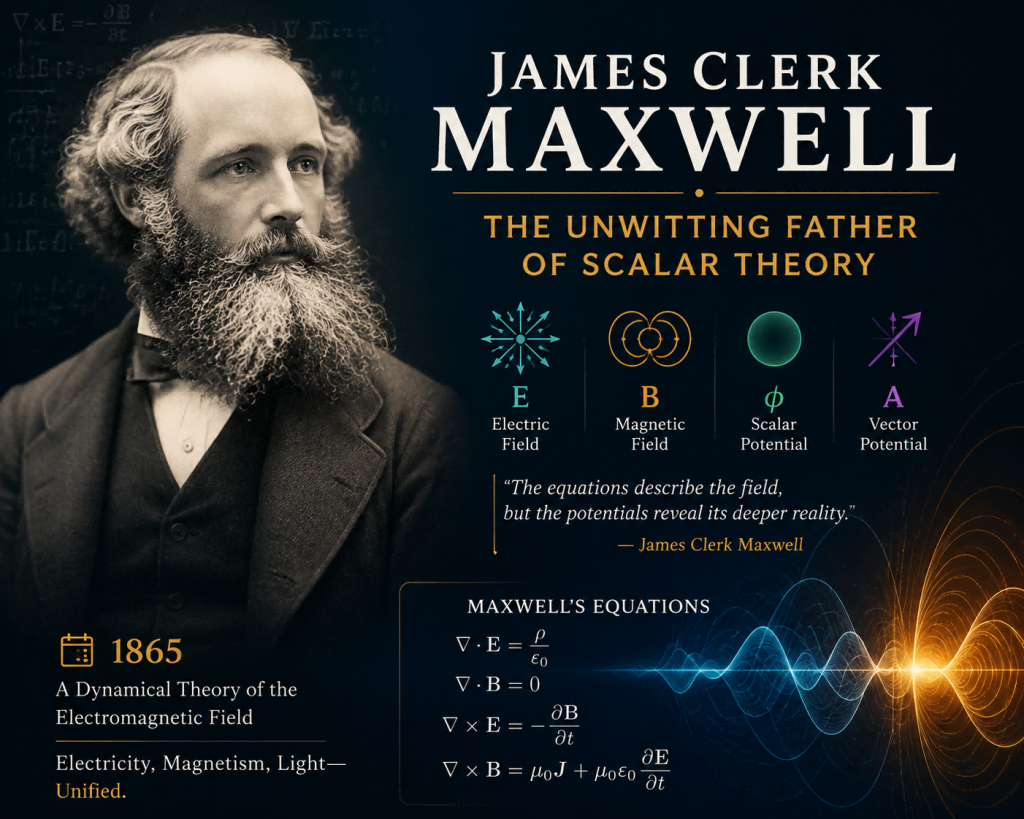
In 1865, Maxwell published A Dynamical Theory of the Electromagnetic Field—one of the most important scientific papers of the nineteenth century. It proposed a unified theory of electricity and magnetism, predicted that electromagnetic waves must exist, and identified light itself as one of those waves. The world we live in today—wireless communication, radar, fibre optics, every technology that uses electromagnetic waves—traces its conceptual origin to that 1865 paper.
Maxwell was not thinking about scalar waves. He never used the term. What he was doing was building the most complete mathematical framework anyone had yet produced for the electromagnetic world. And that framework contained something that would matter enormously to a different set of thinkers, more than a century later.
Maxwell’s intellectual journey was shaped by his deep commitment to understanding the physical world through unified principles.
He was heavily influenced by Michael Faraday, who had introduced the concept of fields as physical entities rather than mere mathematical abstractions. Maxwell’s great achievement was to translate Faraday’s qualitative vision into precise mathematical language. Unlike many of his contemporaries, Maxwell never lost sight of the physical reality behind the equations. He was not content with mathematics that merely predicted experimental results—he wanted to understand what the mathematics actually meant about the nature of the physical world.
Part 2: What the Original Paper Actually Said
The 1865 paper presented twenty equations involving twenty variables. The exact number varies depending on how you count vector components—some sources say eight, some thirteen, some twenty. The number is not the point. The architecture is.
In Maxwell’s original framework, the electromagnetic world contained four fundamental categories of physical quantity:
- The electric field E— a vector field, with a direction at every point in space
- The magnetic field B— also a vector field
- The scalar potential φ(phi) — a single number at every point in space, with no direction
- The vector potential A— an arrow at every point in space, indicating both magnitude and direction
All twenty equations described the relationships among these four quantities—how the fields arise from the potentials, how charges and currents generate them, how they evolve through time. The mathematics was cumbersome by modern standards, but the physical picture was remarkably complete.
The scalar potential, in Maxwell’s framework, was not a calculation shortcut. It was a real physical quantity—something that existed in space, that had measurable effects, that was as fundamental as the electric or magnetic field. Maxwell understood that the electric field could be derived from the scalar potential, but he did not therefore conclude that the scalar potential was merely a mathematical convenience. He treated it as something that physically existed, with its own ontological status.
This view was consistent with his broader philosophical approach to physics. Maxwell believed that the mathematical structures he was using corresponded to real features of the physical world. The potentials were not just useful fictions—they were part of the actual furniture of the universe. But that view did not survive the decade after Maxwell’s death.
Part 3: Enter Heaviside: The Man Who Simplified Everything
Oliver Heaviside was born in England in 1850, nineteen years after Maxwell. He never attended university. He worked as a telegraph operator, taught himself mathematics, and became one of the most important electrical engineers and applied mathematicians of his era. Heaviside was largely self-taught, yet he made fundamental contributions to the development of vector calculus, operational calculus, and transmission line theory. His work on telegraphy was directly responsible for making long-distance communication practical.
In the 1880s, Heaviside did something that transformed physics and engineering: he rewrote Maxwell’s twenty equations using a new mathematical language called vector calculus, compressing them into the four compact equations that physicists still use today. This was an enormous achievement. The four-equation version was simpler, more elegant, and vastly easier to use for practical calculations. It made electromagnetic theory accessible to engineers and students in a way that Maxwell’s original formulation never could have been.
But Heaviside did more than compress. He had a strong philosophical position on what the equations actually meant, and he made sure his version reflected it. His view was clear: only the fields are physically real. The potentials—including the scalar potential—are nothing more than mathematical conveniences. Useful tools for calculation. Not things that actually exist in the world.
This philosophical position was not arbitrary. Heaviside was a pragmatic thinker who cared about what could be measured and applied. Fields could be measured. They had observable effects. Potentials, on the other hand, were gauge-dependent. You could change the scalar potential by adding a constant without changing any observable physical effect. This led Heaviside to conclude that potentials were not physically real—just mathematical scaffolding that could be discarded once the calculations were done.
So in Heaviside’s four-equation version, the scalar potential disappears as a physical object. It is still present mathematically, used in certain calculations. But it is no longer treated as something fundamental. For electrical engineering and most of practical physics, this made absolutely no difference. The four-equation version predicts everything the twenty-equation version predicts, for every standard electromagnetic phenomenon. Heaviside’s compression was a genuine achievement, not a mistake.
But on one specific question—whether the potentials have physical reality—the two versions gave different answers. And that difference would sit quietly in the background of physics for nearly a century before it became important again.
Part 4: The Aharonov–Bohm Effect: Physics Comes Back to Maxwell
In 1959, two physicists—Yakir Aharonov and David Bohm—published a paper that changed the theoretical landscape of physics. They predicted that an electron moving through a region of space where the electric and magnetic fields are both exactly zero—but where the electromagnetic potential is non-zero—would still be measurably affected. Its quantum phase would shift. A real, detectable physical effect, produced by a potential, in a region with no field.
If Heaviside was right—if potentials are just mathematical tools with no physical reality—this should not happen. There is no field, so there should be nothing there to affect the electron. The electron would pass through the region as if nothing were there. The prediction was radical precisely because it challenged the field-only ontology that had become standard in physics.
Experiments confirmed that it does happen. The Aharonov–Bohm effect is now one of the most well-established results in quantum mechanics. It is taught in graduate physics courses. It appears in textbooks. It is not controversial. The experiments required extremely precise control of electron beams and magnetic fields. But over the decades, multiple independent groups have confirmed the effect with ever-increasing precision. The phase shift predicted by Aharonov and Bohm has been observed and measured. The effect is real.
And what it means, unambiguously, is this: Maxwell was right and Heaviside was wrong—on the specific question of whether the potentials have physical reality. The scalar potential is not a mathematical convenience. It is something that exists in the world and produces measurable effects, even when the familiar electric and magnetic fields are absent.
This is not a fringe interpretation. It is the standard interpretation in mainstream physics. Textbooks on quantum mechanics routinely discuss the Aharonov–Bohm effect as a demonstration that electromagnetic potentials are physically real. The shift from Heaviside’s position to Maxwell’s original position is one of the quiet revolutions in twentieth-century physics—quiet because it did not change any practical calculations, only the interpretation of what the calculations actually represent.
Part 5: Why This Matters for Scalar Research
Maxwell never used the word “scalar” in the way it is used in scalar wave research today. He did not coin the term. He did not predict the therapeutic applications. He died in 1879—the questions that dominate the modern scalar field were not even on anyone’s agenda yet.
What he did do was lay down the original twenty-equation framework—one in which the scalar potential was a real, fundamental physical quantity. That framework is what later scalar theorists—Tesla, Meyl, Bearden, and others—pointed back to when they argued that something important had been lost in the Heaviside compression.
Their argument was not that Heaviside made a mathematical error. He did not. Their argument was that in simplifying Maxwell’s framework for practical engineering purposes, something physically real—a category of phenomenon that the scalar potential represented—was effectively erased from the working model that physicists and engineers used going forward.
Whether that argument is correct—whether there are physically real effects associated with scalar potentials that go beyond what Heaviside’s framework describes—is exactly the question that scalar research is trying to answer. It is a legitimate scientific question. It has a legitimate historical basis. And the starting point—the scalar potential as a real physical object—has now been confirmed by mainstream physics through the Aharonov–Bohm effect.
That is why Maxwell is called the unwitting father of scalar theory. He was not trying to found this field. The seed of the concept was simply there, in his original work—waiting for the questions that would later grow around it.
Part 6: Where This Leaves Us
The story of Maxwell, Heaviside, and the scalar potential is a story about what gets included in a scientific framework—and what gets quietly left out when we simplify.
The simplified version worked beautifully. It still does. Modern electrical engineering, wireless communication, and electromagnetic technology are built on the four-equation Heaviside version, and they work. Nobody is suggesting we go back to twenty equations for everyday calculations.
But “works for most purposes” and “complete” are different things. And the Aharonov–Bohm effect tells us, clearly, that the simplified version is not complete—that there are physical phenomena associated with electromagnetic potentials that it does not fully represent.
What scalar researchers are asking—at their best—is: what else might be in that gap? What other effects might exist in the domain of electromagnetic potentials that we stopped looking for, once we adopted the simplified framework as the whole story?
Those are good questions. Maxwell, the unwitting father, did not answer them—he was not asking them. But the framework he left behind is the reason they are worth asking at all.
Resources:
- [1] Maxwell, J. C. (1865). A dynamical theory of the electromagnetic field. Philosophical Transactions of the Royal Society of London, 155, 459–512.
- [2] Hunt, B. J. (2005). The Maxwellians. Cornell University Press.
- [3] Aharonov, Y., & Bohm, D. (1959). Significance of electromagnetic potentials in the quantum theory. Physical Review, 115(3), 485–491.
- [4] Bearden, T. E. (2002). Energy from the Vacuum: Concepts and Principles. Cheniere Press.
- [5] Griffiths, D. J. (2017). Introduction to Electrodynamics (4th ed.). Cambridge University Press.
- [6] Meyl, K. (2001). Scalar Wave Transceiver Technology. INDEL GmbH.
- [7] Peat, F. D. (1990). Einstein’s Moon: Bell’s Theorem and the Curious Quest for Quantum Reality. Contemporary Books.
- [8] O’Rahilly, A. (1938). Electromagnetics: A Discussion of Fundamentals. Cork University Press.