The other articles in this series traced a historical arc: Maxwell wrote the scalar potential into his equations. Heaviside removed it as a physical object. Tesla took the underlying question into the laboratory. Aharonov and Bohm confirmed, in 1959, that the potentials are physically real after all. That is where the scientific story stood for most of the 20th century — interesting, contested, but largely confined to physics departments and the fringes of energy research. Something has changed in the decades since. Scalar concepts have moved from the laboratory fringe into a surprising range of practical contexts.
This article looks at where scalar energy — as a concept, as a theoretical framework, and as a set of claimed physical effects — shows up in the world today. The applications range from areas with serious scientific grounding to areas where the evidence is thin and the claims run well ahead of what can currently be verified. We will treat them with the same honesty we have tried to apply throughout this series: neither dismissing everything nor accepting everything, but mapping the territory as clearly as we can.
Part 1 — First, a Note on What 'Applications' Means Here
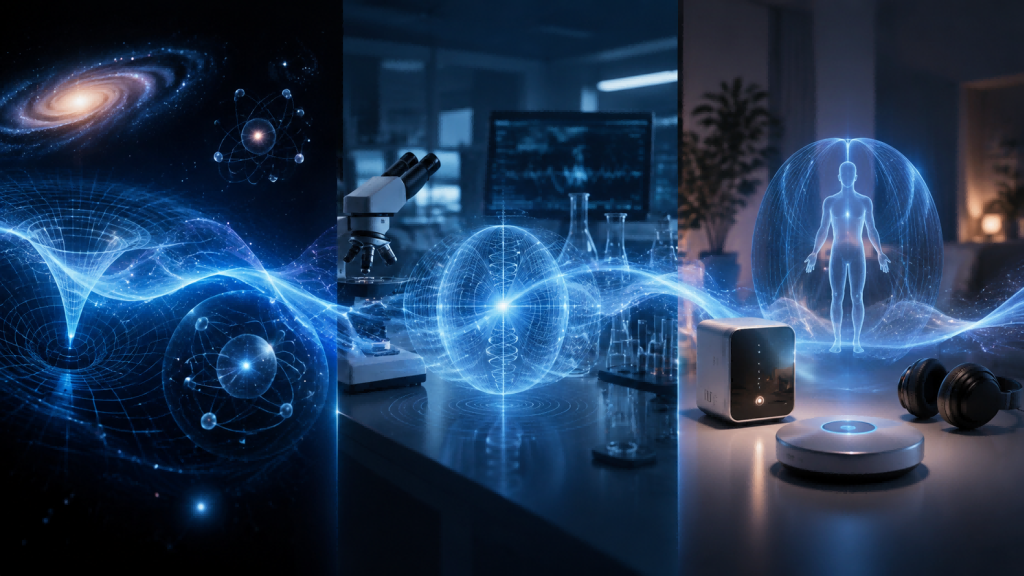
When we talk about modern applications of scalar energy, we are talking about at least three different things that often get conflated.
The first is applications of scalar fields in mainstream physics and technology. Scalar fields are real, accepted objects in physics, and they appear in some of the most important technologies of the 21st century. This is not controversial.
The second is research programmes that use scalar concepts — particularly the idea that longitudinal electromagnetic waves or electromagnetic potentials can carry information and interact with biological systems — to design experiments and develop technologies for health and energy applications. This is at the edge of mainstream science: some of it is being investigated seriously, some of it is not yet being investigated rigorously enough to know.
The third is commercial products and wellness services that invoke scalar terminology to describe their claimed effects. This is the largest and most varied category — and the one that most requires careful, case-by-case evaluation.
Understanding which category a given claim belongs to is the first step toward evaluating it honestly.
Part 2 — Scalar Fields in Mainstream Science and Technology
It is worth starting here, because it establishes something important: scalar field applications are not the exclusive property of alternative health. They are at the heart of the most advanced science happening today.
Cosmology and dark energy
Some of the most actively discussed models in contemporary cosmology involve scalar fields. The leading candidate for what drives the accelerating expansion of the universe — what physicists call dark energy — is a slowly evolving scalar field, often called quintessence. In 2024, the Dark Energy Spectroscopic Instrument (DESI) published baryon acoustic oscillation measurements that showed a preference for evolving dark energy over a simple cosmological constant, at statistical significance between 2.6 and 3.9 sigma [1]. If confirmed, this would be observational evidence that a dynamic scalar field is shaping the large-scale evolution of the universe. This is not fringe science. It is the frontier of cosmological research.
Quantum computing and scalar quantum field theory
Scalar quantum field theories are among the primary targets for simulation on near-term quantum computers. The simulation of φ4 scalar field theory — a foundational model in particle physics — has been demonstrated on actual quantum hardware, with results showing the potential for quantum computational advantage over classical approaches [2]. This line of research connects scalar field physics directly to one of the most intensively funded technology areas in the world.
The Higgs field in everyday reality
The Higgs field — confirmed by CERN’s Large Hadron Collider in 2012 — is the reason every particle in the universe has mass. Without it, electrons would travel at the speed of light, atoms could not form, and chemistry — and therefore life — would be impossible. Its confirmation as a pervasive scalar field operating throughout all of space is the clearest possible demonstration that scalar fields are not exotic. They are the fabric of physical reality [3].
The significance of this for the broader scalar conversation: anyone who tells you that scalar fields are an invented concept with no basis in real physics has not been paying attention to what CERN has been doing for the past decade.
Part 3 — Scalar Concepts in Health Research
Moving from confirmed physics into the more contested territory of scalar health research, we find a landscape that is genuinely mixed — real experiments with real results that have not been fully explained, sitting alongside claims that outstrip the available evidence significantly.
The Schumann resonances and biological rhythms
The Schumann resonances — the electromagnetic resonant frequencies of the Earth-ionosphere cavity that Tesla was arguably trying to access at Colorado Springs — are now a well-established physical phenomenon, measured continuously by monitoring stations worldwide. The fundamental Schumann frequency is approximately 7.83 Hz, with harmonics at 14.3 Hz, 20.8 Hz, and higher [4].
What is genuinely interesting from a biological perspective is that these frequencies overlap with the range of human brainwave activity — alpha (8–13 Hz) and theta (4–8 Hz) bands. A number of researchers have proposed that biological rhythms may have co-evolved with or be entrained by Schumann resonances, given that life on Earth has evolved within this electromagnetic environment for billions of years [4]. This hypothesis is taken seriously enough to be investigated by mainstream researchers, though a causal mechanism has not been established. Some studies have found correlations between Schumann resonance activity and human cardiovascular and neurological rhythms; others have not found clear effects. The question is genuinely open.
Biophoton research and cellular communication
The work of Fritz-Albert Popp on biophoton emission — which we referenced in the first article of this series — has continued to develop as a research field. There are now multiple laboratories internationally studying whether the ultra-weak light emitted by living cells serves a communicative function [5]. The emission itself is confirmed and measurable. The communication hypothesis — that cells use coherent biophoton signals to coordinate biological processes — remains unconfirmed but is generating serious experimental work. If confirmed, it would provide a direct biological mechanism for the kind of energetic information transfer that scalar health approaches generally propose, without requiring any departure from known physics.
Electromagnetic field effects on cells and tissues
The broader field of bioelectromagnetics — the study of how electromagnetic fields interact with living systems — has accumulated a substantial research base over the past several decades. PEMF therapy has FDA approval for specific indications including bone fracture healing and transcranial magnetic stimulation for depression. More broadly, the literature on how oscillating electromagnetic fields affect cell membrane potential, ion channel activity, and gene expression is extensive and growing [6].
Scalar wave advocates argue that the effects attributed to conventional PEMF and electromagnetic fields may be, at least in part, effects of the electromagnetic potential rather than the field itself — consistent with the Aharonov–Bohm finding that potentials produce physical effects even where fields are zero. This is a specific and testable hypothesis. Whether it is correct is not currently established. But it illustrates how scalar concepts can make contact with mainstream bioelectromagnetics research in specific, falsifiable ways rather than simply asserting effects without mechanism.
Part 4 — Commercial Scalar Applications: The Current Landscape
This is the category most people encounter first when they search for scalar energy — and the one that requires the most careful navigation. Commercial scalar devices and wellness services have grown significantly in the past decade. The range is wide: from simple imprinted jewellery to sophisticated multi-unit clinical installations.
The Energy Enhancement System (EESystem)
Developed over more than two decades by Dr. Sandra Rose Michael, the Energy Enhancement System is perhaps the highest-profile commercial scalar technology currently operating. The system uses arrays of custom-configured computers whose screens are arranged to create what the technology describes as a bio-scalar field — a morphogenic energy field claimed to promote cellular regeneration, immune support, and neurological balance [7].
EESystem centres operate worldwide, typically offering sessions in which users recline in a room surrounded by the system’s screen arrays for one to several hours. The reported experiences of users — and there are now very large numbers of them — include deep relaxation, pain reduction, improved sleep, and in some cases more dramatic health changes. A case study involving the significant reduction of seizure activity in a paediatric patient was published in the peer-reviewed Journal of Neurology Research [7].
The honest evaluation of EESystem is complicated by the nature of the evidence. The published research consists primarily of case studies, observational reports, and proprietary measurements using specialised instruments — including Kirlian photography and live blood microscopy — that are not standard in mainstream medicine. The system itself acknowledges that conventional laboratory equipment designed for Hertzian frequencies may not be adequate to characterise the non-Hertzian nature of the fields it claims to generate [7]. This is a coherent position within the scalar framework. It is also, practically speaking, a significant challenge for independent verification. The experiential evidence from users is substantial. The controlled clinical evidence is not.
Spooky2 Scalar
Spooky2 Scalar — developed within the broader Spooky2 frequency therapy ecosystem by John White and a large collaborative research team — represents what is arguably the most technically detailed home-based scalar system currently available. The device uses a two-coil opposing-field architecture to create a resonant interference zone between a Transmitter and Receiver coil, within which the user sits or sleeps. It supports four operational modes — Pure Scalar, Molecular Scalar, Rife Scalar, and Scalar Harmony — each adding different layers of frequency or molecular information to the base scalar field [8].
What distinguishes Spooky2 Scalar within the commercial scalar space is the level of theoretical and technical documentation the team has produced, and the size of the practitioner community that uses and reports on it — now numbering in the tens of thousands globally. The system has been integrated into clinical practice by a number of practitioners internationally, and is used alongside conventional medical care rather than as a replacement for it.
As with EESystem, the evidence base consists primarily of practitioner observation and user reporting rather than controlled clinical trials. The platform is transparent about this. The working position of the Spooky2 community is that the scalar field produces measurable effects — in user wellbeing, in biofeedback responses, in the frequency signatures of imprinted water — that are consistent with the theoretical framework, and that rigorous clinical investigation is a goal rather than an established achievement [8].
Aha Halo: Scalar in Your Pocket
A more recent development in the scalar application space is the emergence of genuinely portable scalar devices — and Aha Halo, developed by Aha Harmony and co-created by John White, is the most notable example currently available. Where Spooky2 Scalar requires a dedicated home setup — two coils placed metres apart, the user sitting between them — Aha Halo brings a scalar field to daily life in a device that weighs 105 grams and fits in a pocket [9].
The device works by converting frequency programs into a scalar energy field that extends approximately one metre (three feet) in all directions from the unit. It comes preloaded with 30 programs and gives access to a growing library of over 100 programmes across twelve wellness categories — pain management, sleep, detox, emotional balance, and more — which can be updated via Windows or Mac software. The battery is designed for durability, retaining 87% capacity after 500 charge cycles [9].
What makes Aha Halo conceptually significant within this category is not just its portability — it is what portability enables. Scalar field exposure, in the Spooky2 and EESystem model, has traditionally required a dedicated session: setting up, sitting within a defined space, allocating time. Aha Halo proposes a different model: continuous, uninterrupted scalar field presence throughout the day, without any session structure. The device is active whenever it is on and near the user — at a desk, on a commute, during sleep.
In this sense, Aha Halo represents a broader shift visible across the scalar and frequency wellness space: the move from session-based to lifestyle-integrated frequency support. The same questions about evidence that apply to other commercial scalar devices apply here — the claimed effects rest on user experience and the theoretical framework rather than controlled clinical data. But as a signal of where the field is heading — toward smaller, always-on, ambient frequency environments rather than discrete clinical interventions — it is worth noting.
Scalar-Adjacent Technologies: PEMF, Wearables, and Imprinted Products
Beyond dedicated scalar systems, a wide range of products that do not always use the scalar label are built on overlapping theoretical foundations. PEMF devices — with an FDA-approved evidence base for specific indications — are increasingly understood by their more theoretically sophisticated users through a scalar lens: the therapeutic effects of pulsed electromagnetic fields may involve the electromagnetic potential as much as the field itself. Wearable frequency devices, frequency-imprinted water and crystals, and molecular imprinting systems all draw on aspects of the scalar framework without necessarily naming it as such.
This adjacent ecosystem is growing rapidly. The PEMF therapy market alone is projected to reach approximately 1.6 billion dollars by 2035. The broader wearable neurotech sector — which includes several devices using scalar-adjacent principles — was valued at over 2 billion dollars in 2025 [10]. These are not marginal numbers.
Part 5 — What to Make of Where We Are
Looking across these three categories — mainstream scalar physics, scalar health research, and commercial scalar applications — a picture emerges that is more coherent than either proponents or critics typically acknowledge.
At the foundational level, scalar fields are doing the most important work in cosmology and particle physics that is currently being done. The Higgs field, quintessence dark energy, scalar quantum field theory — these are where the biggest scientific questions of our time are being addressed. Scalar is not a marginal concept in physics. It is central.
At the research level, the questions that scalar health researchers are asking — whether electromagnetic potentials interact with biological systems in ways that go beyond what standard field-based models capture, whether biophotons carry biological information, whether the Schumann resonance environment has shaped biological rhythms — are legitimate scientific questions. Some are being seriously investigated. None are settled. The path from these open questions to specific therapeutic protocols is longer and less direct than commercial claims often suggest.
At the commercial level, the gap between the claims made by scalar wellness products and the evidence available to support those claims varies considerably. Some providers are honest about this gap and position their technology as an emerging field with promising early results rather than a clinically validated treatment. Others make claims that significantly outstrip the evidence. The distinction matters, and readers deserve to know which they are encountering.
The most intellectually honest position on modern scalar applications is probably this: the theoretical foundation is real and significant. The research questions are legitimate and interesting. The commercial applications are promising in some cases, unverified in others, and require honest case-by-case evaluation. That is not a disappointment. It is where a young field with genuine foundations naturally finds itself — and it is a more interesting place to be than the clean certainty of either true belief or reflexive dismissal.
Resources:
- [1] DESI Collaboration. (2024). DESI 2024 VI: Cosmological Constraints from the Measurements of Baryon Acoustic Oscillations. arXiv:2404.03002.
- [2] Ciavarella, A. N., & Casanova, S. (2021). Preparation of the SU(2) vacuum in a quantum simulator. Physical Review Research, 3(1), 013104.
- [3] ATLAS Collaboration. (2012). Observation of a new boson at a mass of 125 GeV with the CMS experiment at the LHC. Physics Letters B, 716(1), 30–61.
- [4] Cherry, N. J. (2002). Schumann resonances, a plausible biophysical mechanism for the human health effects of solar/geomagnetic activity. Natural Hazards, 26(3), 279–331.
- [5] Popp, F. A., & Beloussov, L. (Eds.). (2003). Integrative Biophysics: Biophotonics. Springer.
- [6] Pilla, A. A. (2013). Nonthermal electromagnetic fields: From first messenger to therapeutic applications. Electromagnetic Biology and Medicine, 32(2), 123–136.
- [7] Michael, S. R. (2023). Technology Briefing: The Energy Enhancement System. EESystem.com.
- [8] Spooky2 Scalar. (2025). Spooky2 Scalar Product Overview and Research Documentation.
- [9] Aha Harmony. (2026). Aha Halo — Portable Scalar Energy Device.
- [10] Market Growth Reports. (2026). PEMF Therapy Device Market Size, Share & Outlook to 2035.