In another article, we looked at how James Clerk Maxwell wrote the scalar potential into his original twenty equations in 1865 — and how Oliver Heaviside, in the 1880s, quietly demoted it to 'just a mathematical tool.' Maxwell had planted the seed. But seeds need someone willing to take them into the lab and find out if they grow. That was Nikola Tesla.
Tesla began his independent research into electrical phenomena in the late 1880s — exactly the period when Heaviside was rewriting Maxwell’s equations and the scalar potential was being quietly sidelined. Whether Tesla knew the details of that debate is unclear. What is clear is that the questions he was asking in his laboratory were, in effect, the same questions the scalar potential raised: can electric potential propagate on its own, through matter, without the transverse electromagnetic wave that standard theory said it had to travel with?
His answer — arrived at through a decade of extraordinary experimental work — was yes. The experiments he conducted trying to prove it are what connect his name so directly to scalar research. And the arc of that work, from the first prototype of the Tesla Coil to the unfinished tower on Long Island, is one of the most dramatic stories in the history of science.
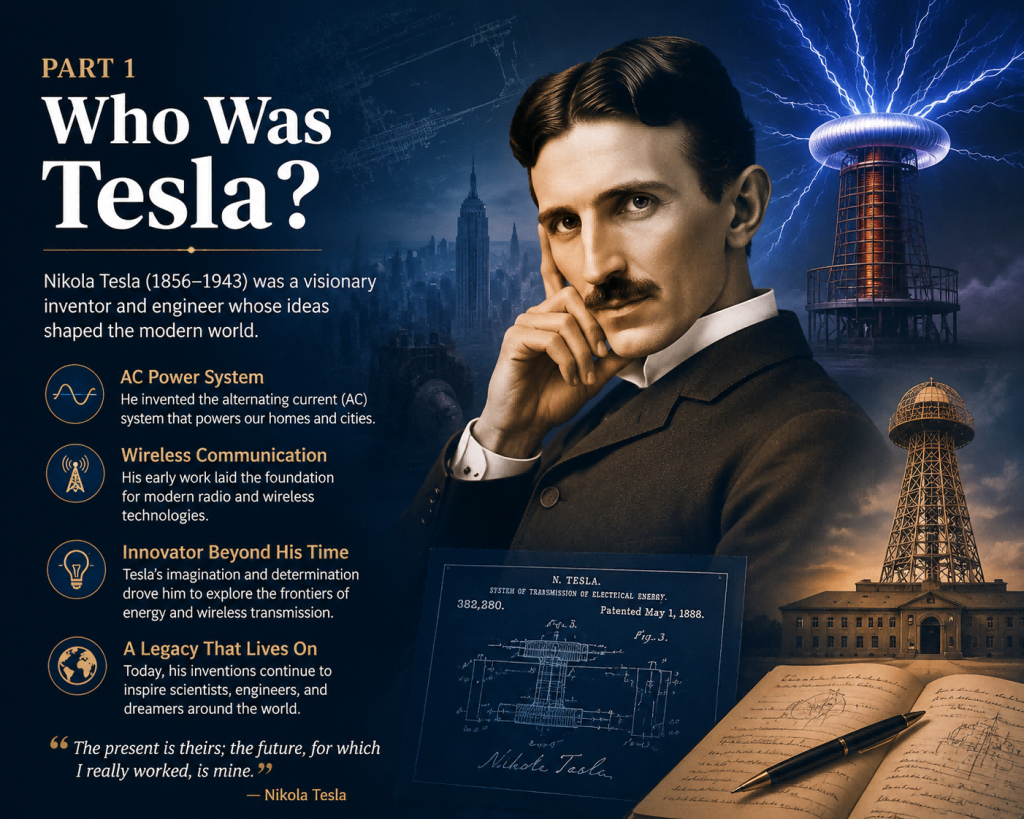
Part 1 — Who Was Tesla?
Nikola Tesla was born in Smiljan, Serbia, in 1856. He died in a New York hotel room in 1943, at the age of 86, largely alone, his finances exhausted and his later projects abandoned.
Between those two endpoints, he changed the world.
Every power outlet you use runs on the alternating current (AC) system he invented and fought for — against Thomas Edison’s direct current alternative, in a conflict that became known as the War of the Currents. The AC system won. The wireless communications we rely on trace back, in part, to patents Tesla filed in the 1890s. The principles of radio transmission were worked out in his laboratory before Guglielmo Marconi’s famous demonstration in 1901 — a priority dispute that Tesla eventually won, though only after his death [1].
He was, in other words, not a fringe inventor with interesting ideas. He was one of the most consequential engineers in the history of modern civilization. His mainstream contributions are not in dispute. What gets discussed in the context of scalar research is a different body of work — experiments he conducted from the late 1880s onward, driven by a question that went beyond the practical applications of alternating current into something more fundamental.
Could energy be transmitted without wires at all? Not through the air as electromagnetic radiation, but through the Earth itself, as a longitudinal disturbance in electric potential?
That question is what drove everything that followed.
Part 2 — The Tesla Coil: Building a Machine to Test the Question
To answer his question, Tesla first needed a device capable of generating electrical oscillations of the kind he was theorizing about. Standard electrical equipment of the era operated at relatively low frequencies. Tesla needed something that could generate extremely high voltages oscillating at high frequency — a device that could create, in effect, a rapidly fluctuating electric potential of enormous amplitude.
The Tesla Coil, developed through the late 1880s and refined throughout the 1890s, was his answer.
The basic principle: a primary coil is driven by a high-frequency alternating current, which transfers energy through loose electromagnetic coupling to a secondary coil. The secondary is designed to resonate freely — to ring like a tuning fork at its own natural frequency, building up oscillation without being tightly constrained by the driving circuit. At the top of the secondary sits a terminal sphere — a smooth metal ball — where the oscillating voltage accumulates to extreme levels. The voltage swings continuously between high and low, back and forth, without stopping. The spectacular electrical arcs that are the Tesla Coil’s most recognizable visual feature are simply the excess energy finding an exit when the voltage exceeds the breakdown threshold of the surrounding air [2].
From the perspective of scalar research, what the Tesla Coil generates at its terminal sphere is a rapidly oscillating electric potential — the scalar potential in motion. Not a transverse electromagnetic wave propagating outward through the air in the conventional sense, but a pulsating voltage disturbance concentrated at a point. Tesla’s working hypothesis was that this oscillating potential could propagate longitudinally — through matter rather than through air, following the Earth as a conductor rather than radiating outward into space.
Standard electromagnetic theory, in Heaviside’s simplified form, said this should not be possible. Longitudinal propagation of electromagnetic disturbances through free space was excluded from the framework. Tesla’s response — characteristically — was not to accept the theoretical conclusion, but to build a larger machine and find out experimentally.
Part 3 — Colorado Springs: Pushing the Coil to Its Limits
In 1899, Tesla leased a plot of land in Colorado Springs, Colorado, and constructed an experimental station specifically designed to test his ideas about wireless energy transmission at scale.
The facility housed a Tesla Coil of unprecedented size. The enlarged secondary coil had a diameter of roughly 15 meters. Above it rose a 57-foot wooden mast, topped with a copper sphere approximately 30 inches across. The system could generate millions of volts of oscillating potential. When operating at full capacity, the artificial lightning discharges it produced stretched dozens of meters in length and were visible for miles in the thin Colorado night air [3].
The scale of what Tesla built in Colorado Springs was not incidental. He was not simply trying to make a bigger version of something he already had. He was trying to establish something specific: whether the Earth itself could serve as the conductor through which electrical energy might propagate globally.
His model of the Earth’s electrical structure was this: the planet itself is a massive conductor. The lower atmosphere — the air we breathe — conducts electricity poorly, acting as an insulator. The upper ionosphere — the thin, electrically active layer at the edge of space — conducts well, acting as a conductor again. Together, the Earth and ionosphere form an enormous natural resonant cavity, like two spherical shells with a poorly conducting gap between them [3].
If you could generate oscillations at the right frequency — the frequency at which standing waves would naturally form within that cavity, bouncing back and forth between the Earth and ionosphere the way waves bounce in a closed basin — then in theory, energy could be extracted from those standing waves at any point on the Earth’s surface. You would not need to beam energy from one specific transmitter to one specific receiver. You would need to excite the entire Earth-ionosphere system into resonance, and then tap into that resonance wherever you happened to be.
Tesla documented his Colorado Springs experiments in detail. His notebooks from 1899 — the Colorado Springs Notes — are a real historical document, subsequently published and available to researchers [3]. In them, he recorded electrical signals he interpreted as evidence of Earth resonance: oscillations that appeared to reflect and reinforce in the way his theory predicted. He concluded that his approach was working.
What Tesla recorded in Colorado Springs has been interpreted in different ways by subsequent researchers. Some physicists have argued that what he detected were conventional electromagnetic phenomena — atmospheric electrical activity, resonances in the ionospheric cavity that would later be confirmed and named the Schumann resonances in the 1950s — rather than the new class of longitudinal wave propagation he believed he was observing. Others in the scalar research tradition argue that Tesla was detecting exactly what he thought he was detecting, and that the conventional interpretation underestimates what he achieved [2].
What is not disputed is that Tesla left Colorado Springs convinced he had found the right direction, and that he was ready to pursue it at the scale the question demanded.
Part 4 — Wardenclyffe: Trying to Turn the Question Into Reality
Colorado Springs was a proof-of-concept facility. What Tesla wanted next was a full-scale transmission system — a permanent station powerful enough to demonstrate, conclusively and publicly, that wireless energy transmission through the Earth was real and practical.
In 1901, backed by funding from financier J.P. Morgan, he began construction of Wardenclyffe Tower on Long Island, New York.
The structure was unlike anything built before or since. A 57-meter wooden tower rose from the Long Island landscape, topped with a 55-ton copper hemispherical antenna — a dome designed to couple efficiently with the Earth’s electrical field. Below ground, the design was equally extraordinary: tunnels and shafts extended roughly 36 meters underground, reaching toward the water table. The underground infrastructure was designed to provide direct electrical coupling with the Earth itself — connecting the tower’s oscillating system to the planet as conductor [4].
The logic of Wardenclyffe was architectural as much as it was electrical. The top of the tower connected to the sky — to the ionosphere above. The base connected to the Earth. The planet and its ionospheric shell were the two terminals of an enormous natural capacitor. Tesla’s transmitter would inject oscillating energy into that capacitor at the right resonant frequency, driving standing waves through the Earth-ionosphere system. Receivers anywhere on the planet’s surface, tuned to that frequency, would be able to extract energy from the resonating system.
It was an audacious vision. And it was never tested.
J.P. Morgan withdrew his funding in 1903, partly due to shifting priorities toward the competing technology of Marconi’s radio broadcasts, and partly due to concerns — reportedly — that a global wireless power system would be impossible to meter and sell commercially. Without funding, construction stalled. The tower stood incomplete on Long Island for years, a landmark that never achieved its purpose. It was eventually demolished in 1917 [4].
Tesla spent the remaining decades of his life trying to revive support for the project and for the broader programme of ideas it represented. He largely failed. By the time he died in 1943, Wardenclyffe was long gone, his ideas about wireless energy transmission through the Earth were considered by mainstream science to be either unproven or mistaken, and his financial circumstances were dire.
Part 5 — What Tesla Left Behind
The failure of Wardenclyffe is one of the great what-ifs in the history of science and technology. Not because it proves Tesla was right — the experiment was never conducted at the scale needed to determine that. But because the question it was designed to answer was never definitively resolved. It was simply abandoned, for financial and commercial reasons, at the moment it was about to be tested.
That unanswered question is part of Tesla’s legacy in scalar research.
The Tesla Coil itself has a more concrete legacy. It is not merely a historical curiosity. The device Tesla developed in the 1890s to generate oscillating electric potential at high frequency and high voltage remains a standard piece of equipment in physics laboratories today, used for high-voltage experiments, plasma research, and electromagnetic demonstrations. The principles it embodies — resonant oscillation, energy storage in an LC circuit, voltage magnification through resonance — are entirely conventional physics [2].
What is less conventional is the interpretation Tesla placed on what the coil was producing. His claim that the oscillating potential at the terminal sphere was a fundamentally different kind of electromagnetic phenomenon — a longitudinal disturbance of the scalar potential rather than a transverse electromagnetic wave — has never been either confirmed or disproven to the satisfaction of mainstream physics. The experiments needed to settle the question were not completed in his lifetime, and the scientific community did not subsequently prioritize completing them.
Konstantin Meyl, whose work was referenced in this series, has argued explicitly that Tesla’s results can be understood within a theoretical framework that takes the scalar potential seriously as a physical quantity — that the phenomena Tesla observed in Colorado Springs and aimed to scale up at Wardenclyffe are real effects of longitudinal wave propagation that the Heaviside simplification of Maxwell removed from view [5]. Whether Meyl’s theoretical framework is correct is a separate question. What it demonstrates is that Tesla’s experimental results have not been simply absorbed and explained by conventional physics — they remain at the edge of what the standard model accounts for.
Tesla took the scalar potential out of the equations and put it in the laboratory. He could not prove, in his lifetime, that what he was working with was real in the way he believed. But he produced results that have not been fully explained by the alternative account either. That is the situation he left to the researchers who came after him.
Part 6 — The Thread That Runs Forward
In the first article of this series, we mapped the current state of scalar science — four research lines, from confirmed foundational physics to unproven commercial applications. Tesla belongs squarely in the second of those lines: experimental exploration, partially accepted, carrying results that are real and documented but whose full interpretation remains open.
In another article, we looked at Maxwell and Heaviside — the theoretical moment in which the scalar potential was demoted from physical quantity to mathematical convenience. The Aharonov–Bohm effect, confirmed in 1959, restored the physical reality of electromagnetic potentials to mainstream physics. But it left open the further questions Tesla had been pursuing: whether those potentials could propagate longitudinally, whether the Earth could serve as a transmission medium, whether a fundamentally different mode of energy transfer was available to the engineer who understood how to use them.
Tesla was the person who first seriously tried to find out. He built the machines, conducted the experiments, documented the results, and came within reach — arguably — of a definitive answer before funding and circumstance pulled it away from him.
Tesla did not live to see it. But the question he carried into his laboratory in the late 1880s — the question that Maxwell’s scalar potential had quietly suggested, that Heaviside’s simplification had suppressed, and that Tesla had the audacity and the engineering skill to try to answer experimentally — was not wrong to ask. That, at minimum, is what history has since established.
Resources:
- [1] Cheney, M. (1981). Tesla: Man Out of Time. Prentice Hall. [Standard biography of Tesla, covering his AC power work, patent disputes, and later research]
- [2] Meyl, K. (2001). Scalar Wave Transceiver Technology. INDEL GmbH. [Meyl’s theoretical interpretation of Tesla’s experimental results within the potential vortex framework; www.meyl.eu]
- [3] Tesla, N. (1978). Colorado Springs Notes, 1899. Nolit. [Tesla’s original experimental notebooks from the Colorado Springs facility, published posthumously]
- [4] Seifer, M. (1996). Wizard: The Life and Times of Nikola Tesla. Birch Lane Press. [Comprehensive biography including detailed account of the Wardenclyffe Tower project and its financing]
- [5] Bearden, T. E. (2002). Energy from the Vacuum: Concepts and Principles. Cheniere Press. [Analysis of Tesla’s experiments within a scalar electromagnetic framework]
- [6] Corum, J. F., & Corum, K. L. (1996). Nikola Tesla and the Magnifying Transmitter. Antenna Compendium, 5. [Engineering analysis of Tesla’s Wardenclyffe Tower design and the Earth-ionosphere resonance model]
- [7] Aharonov, Y., & Bohm, D. (1959). Significance of electromagnetic potentials in the quantum theory. Physical Review, 115(3), 485–491. https://doi.org/10.1103/PhysRev.115.485 [Referenced as the 1959 experiment that restored physical reality to electromagnetic potentials in mainstream physics]
- [8] Hunt, B. J. (2005). The Maxwellians. Cornell University Press. [Historical context of the Maxwell–Heaviside rewrite that Tesla’s work implicitly challenged]