Two extremes dominate the conversation about scalar energy online. One side claims it can heal almost anything. The other dismisses it entirely as pseudoscience. Neither position is accurate—and neither is particularly useful.
Scalar research is not one thing. It is a 160-year-old field with multiple research lines running in parallel—some fully accepted by mainstream science, some sitting at the legitimate edge of current inquiry, and some still waiting for the kind of rigorous investigation they deserve.
This article tries to lay out where things actually stand. Not to sell you on scalar. Not to dismiss it. Just to give you a clear, honest map of the terrain.
Part 1: What People Mean When They Say "Scalar"
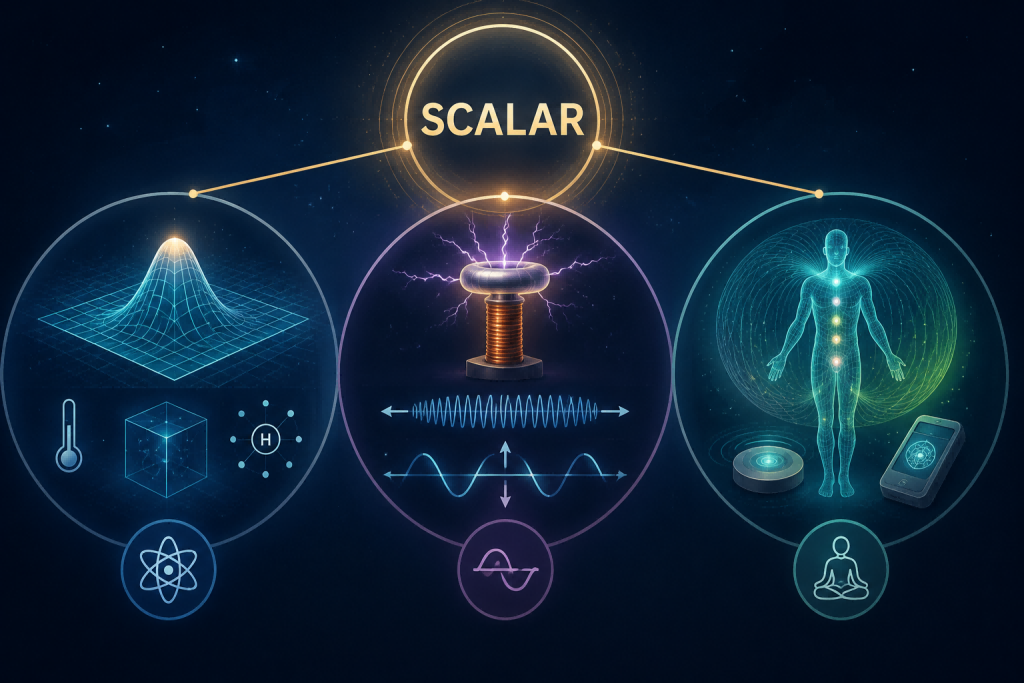
The word “scalar” gets used in at least three different ways, and mixing them up is one of the main reasons conversations about this topic go sideways.
In mainstream physics, a scalar field simply means a field that assigns a single number—not a direction—to every point in space. Temperature is a scalar field. The Higgs field is a scalar field. In this sense, scalar fields are completely ordinary and fully accepted. There is nothing controversial about them. They are taught in introductory physics courses and form the basis for large portions of modern theoretical physics.
In the Tesla and Meyl tradition, “scalar waves” refers to a proposed class of longitudinal electromagnetic waves—waves that oscillate in the same direction they travel, rather than perpendicular to it. This is where the physics gets disputed. Standard electromagnetic theory says longitudinal EM waves cannot propagate in free space. Meyl and others argue that the standard framework was simplified in ways that excluded this possibility—that Maxwell’s original formulation actually allowed for longitudinal solutions that were lost in the Heaviside compression.
In the wellness space, “scalar energy” often refers to a broader biofield concept—a subtle energy or informational field that may influence biological processes. This is the least formally defined of the three uses, and the most distant from established physics. It is also where most of the commercial products operate, and where most of the overclaiming happens.
Keeping these three uses separate is not just academic pedantry. It matters because the evidence for each is very different—and because conflating them is how both overclaiming and unfair dismissal happen.
Part 2: What Mainstream Science Has Already Accepted
This is where most discussions about scalar start going wrong—by skipping this section entirely.
The mathematical and conceptual foundation of scalar phenomena is not disputed. It lives in mainstream textbooks. The following are not controversial:
Maxwell’s scalar potentials. James Clerk Maxwell’s original 1865 electromagnetic framework treated the scalar potential as a fundamental physical quantity. When Oliver Heaviside rewrote Maxwell’s equations in vector calculus form in the 1880s, he demoted the potentials to mathematical conveniences. This simplification is why most physics students never encounter scalar potentials as physical objects. But the fact that they were simplified out of the teaching curriculum does not mean they were simplified out of reality.
The Aharonov–Bohm effect. In 1959, Aharonov and Bohm predicted—and experiments later confirmed—that electromagnetic potentials have measurable physical effects on electrons even in regions where the electric and magnetic fields themselves are exactly zero. This is a direct experimental demonstration that the potentials are not merely mathematical tools. They are physically real. This finding is fully accepted by mainstream physics and is taught in quantum mechanics courses worldwide.
The Higgs field. The Higgs field—whose associated particle was confirmed experimentally at CERN in 2012—is, technically, a scalar field. It assigns a single value to every point in space, has no direction, and is responsible for giving elementary particles their mass. Its confirmation was celebrated as one of the great achievements of modern physics and won the Nobel Prize in 2013. Nobody calls the Higgs field pseudoscience.
Biophoton emission. Living cells emit ultra-weak light—biophotons—as a normal byproduct of metabolic processes. This has been confirmed by numerous research groups and is not disputed. What remains open is whether biophotons play an active role in cell-to-cell communication, as Fritz-Albert Popp proposed. The emission is accepted; the communication hypothesis is still being investigated.
The point is simple: the conceptual foundation that scalar researchers point back to is not fringe. The roots are in mainstream physics. The question is what grows from those roots.
Part 3: Four Research Lines, Four Different Statuses
A clearer way to look at the scalar field is to separate it into four distinct lines of inquiry, each with its own history and current standing.
Line 1: Foundational Physics — Mainstream
Maxwell’s potentials, the Aharonov–Bohm effect, the Higgs field. All of this is accepted physics. The mathematical framework that scalar theorists later invoked as their foundation exists and is real. This is the ground floor. Anyone who denies the physical reality of scalar potentials in the quantum context is simply wrong about the physics.
Line 2: Experimental Exploration — Partially Accepted
Nikola Tesla’s coil experiments demonstrated longitudinal electrical wave phenomena that he described as fundamentally different from standard Hertzian waves. Tesla’s experimental results were real and reproducible—what they actually demonstrate, and whether they require a new theoretical framework to explain, is still discussed among physicists.
Konstantin Meyl, whose transmitter-receiver apparatus demonstrations have been replicated by independent researchers, argues that his devices transmit energy via scalar (longitudinal) waves that propagate faster than light and carry magnetic vortex structures not described by standard EM theory. His theoretical framework remains outside mainstream acceptance. His experimental results are harder to dismiss.
Line 3: Bio-Medical Exploration — Interrupted, Not Abandoned
Antoine Priore conducted experiments in France in the 1960s and 1970s in which complex electromagnetic fields appeared to induce remission in animal cancer models. Some of his results were published in Comptes Rendus de l’Académie des Sciences—one of France’s most prestigious scientific journals. Funding was later withdrawn, the research was not continued, and the mechanism was never established. The experiments have not been formally replicated. They have also not been formally refuted.
Fritz-Albert Popp’s biophoton research opened the question of whether light emitted by cells carries biological information. Popp spent decades building an evidence base for this hypothesis. It remains controversial, but it is being investigated by a small but active community of researchers.
Meyl’s paper proposing that DNA functions as an antenna for scalar waves—published in DNA and Cell Biology in 2012—was retracted by the journal in 2013. Retraction is a serious matter. It means the journal no longer stands behind the paper. It does not, on its own, mean the hypothesis is wrong. The hypothesis remains unvalidated and under scrutiny.
Line 4: Commercial Applications — Under Evaluation
A number of commercial devices now claim to generate and apply scalar fields for therapeutic purposes. EESystem, Scalar Light, and Spooky2 Scalar are among the more prominent examples. These are products, not research programs. Some have practitioner communities with substantial collective experience. Some users report significant benefits.
But the evidentiary standard for clinical practice is higher than the evidentiary standard for personal experience. None of these devices has yet produced the level of peer-reviewed clinical evidence that would bring scalar therapy into mainstream medical practice. That gap between experiential evidence and clinical validation is where most of the honest debate currently lives.
Part 4: What to Make of All This
Here is what we think is fair to say, based on a careful look at the actual research:
The foundation is real. Scalar fields, electromagnetic potentials, and their physical effects exist within mainstream physics. Anyone who dismisses all scalar discussion as pseudoscience has not looked carefully at the physics. The Aharonov–Bohm effect alone is enough to demonstrate that the potentials are physically real. The Higgs field is a scalar field. These are not fringe claims—they are textbook physics.
Most of the interesting territory is open. The bio-medical applications, the longitudinal wave hypothesis, the question of whether electromagnetic fields carry biological information—these are not settled questions. “Not yet proven” is not the same as “not real.” The history of science is full of phenomena that were dismissed before they were understood.
The commercial space requires honest evaluation. Not every device claiming to generate therapeutic scalar fields is delivering what it claims. Some are operating from a genuine theoretical framework. Some are not. The presence of real science in the foundation does not automatically validate every product built on top of it.
Personal experience is data—of a particular kind. The practitioner communities around scalar devices include many people reporting genuine benefits. This experiential evidence is real. It is also not the same as controlled clinical evidence, and both things can be true simultaneously.
Scalar is not one thing. It is a field—in the broader sense—with a 160-year history, multiple distinct research threads, a legitimate scientific foundation, and a genuinely unsettled frontier. The most useful position is not belief or dismissal. It is curiosity with clear eyes.
Resources:
- [1] Griffiths, D. J. (2017). Introduction to Electrodynamics (4th ed.). Cambridge University Press.
- [2] Meyl, K. (2001). Scalar Wave Transceiver Technology. INDEL GmbH.
- [3] Priore, A. (1966). Procédé et dispositif de production de rayonnements utilisables notamment pour le traitement de cellules vivantes. Comptes Rendus de l’Académie des Sciences.
- [4] Maxwell, J. C. (1865). A dynamical theory of the electromagnetic field. Philosophical Transactions of the Royal Society of London, 155, 459–512.
- [5] Aharonov, Y., & Bohm, D. (1959). Significance of electromagnetic potentials in the quantum theory. Physical Review, 115(3), 485–491.
- [6] Popp, F. A., Ruth, B., Bahr, W., Böhm, J., Grass, P., Grolig, G., … & Nagl, W. (1981). Emission of visible and ultraviolet radiation by active biological systems. Collective Phenomena, 3, 187–214.
- [7] Oschman, J. L. (2000). Energy Medicine: The Scientific Basis. Churchill Livingstone.
- [8] Bearden, T. E. (2002). Energy from the Vacuum: Concepts and Principles. Cheniere Press.